Systems | Development | Analytics | API | Testing

Appian Q3 Release Highlights: AI Speed Meets Enterprise Controls

AI is evolving faster than organizations can keep up, and often it’s the most important operations that fall the furthest behind. That’s exactly why Appian is focused on AI for complex, enterprise-grade processes—to make applying AI automation to important work easy. Over the last quarter, Appian has continued to invest in capabilities that help you deploy AI fast without sacrificing control: Over 80% of developers regularly use AI coding tools.


Intelligent Document Processing Platform: 4 Must-Have Features for 2027

An intelligent document processing (IDP) platform uses AI technologies to automatically capture, classify, extract, validate, and route data from unstructured documents such as invoices, contracts, emails, PDFs, or even hand-written scans. As organizations continue to adopt AI into their daily workstreams, IDP is on track to shift from a back-office efficiency tool to a core component of enterprise AI automation.

Human Judgment Is the Missing Variable in Your AI Strategy

Across teams, organizations, and industries, people are starting with AI instead of the problem they want to solve. As a result, AI outputs from different tools: This is a process failure, and it's accelerating. Human-in-the-loop (HITL) AI is a framework that integrates human oversight directly into the machine learning lifecycle. Rather than relying on fully autonomous systems, HITL uses humans and machines collaboratively to train models, evaluate outputs, and handle complex decision-making.

Data Integration in the Life Sciences: Eliminate Data Silos for Good

In the life sciences industry, where breakthroughs in research and healthcare are fueled by data, data silos can be a big problem. Data silos might be caused by things like legacy systems, departmental divisions, disparate data formats, or lack of interoperability standards. Data silos can manifest at any point in the product lifecycle and make it hard for the right people to access and use the information they need, when they need it.

Best Practices for Modernizing Your Payment Investigation Process with AI

AI agents are proliferating faster than most institutions can govern them and the primary challenge is quickly becoming an "accountability gap." Disconnected pilots rarely scale into accountable, auditable operations. The financial services industry is currently at a tipping point: banks must bridge the gap between initial AI enthusiasm and operational reality.

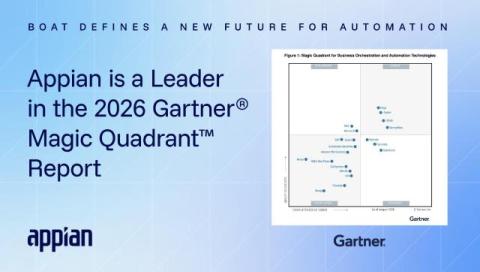
BOAT Defines a New Future for Automation: Appian is a Leader in the 2026 Gartner Magic Quadrant Report

Over the past few decades of digital transformation, organizations have accumulated separate tools for separate jobs: RPA for UI automation, BPM for workflow management, iPaaS for API integrations, and other point solutions. These investments have delivered undeniable productivity gains. But they've also created challenges: systems that don’t talk to each other, processes that break across integrations, and IT teams that spend more time maintaining the technology rather than innovating with it.

Automated Document Processing: 5 Examples and Key Benefits

Automated document processing, also known as intelligent document processing (IDP), uses artificial intelligence and machine learning to reduce the manual effort required to extract data from paper or digital documents. Why is that vital? As organizations continue to modernize in their workflows, enterprises still need to grapple with enormous volumes of documents, such as invoices, receipts, and contracts. Manual data entry and rekeying of document data creates an operational bottleneck.

Unifying Data with Appian Data Fabric

When information is spread across disconnected systems, it becomes difficult and time-consuming to find the right information, make informed decisions, and move work forward. Take, for example, planning a weekend getaway with friends: you have to review airline portals, manage a shared Google Doc for the itinerary, orchestrate a flurry of WhatsApp chats, and book an Airbnb reservation. Making decisions with this much information sprawl becomes exhausting.

Customer Service AI Orchestration: Smart Intake Isn't Enough

Customer service AI orchestration connects AI-driven intake to the backend systems and people who actually resolve a request, not just the chatbot that receives it. Every request should trigger an end-to-end resolution, not stop at an automated response. The real challenge with AI in customer service isn’t adoption; it’s fragmentation.

Application Tuning: Getting More from What You Already Have

Enterprise IT leaders are often caught between the pressure to innovate and the demands of maintaining their current tech. When a system slows down or struggles to scale, it can be hard to know what to do. Rather than being stalled by uncertainty or getting distracted by fixes that don’t solve the underlying problems, Appian’s Customer Success experts encourage our customers to start with a core thesis: non-invasive application tuning should always be your first line of attack.