


|
By Shannon Thompson
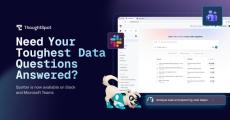
Your data warehouse can tell you that pipeline dropped. It can't tell you why, because the reason sits in a sales call, a support ticket, or a thread in your team chat. When your AI analyst can't reach those places, you end up doing the last mile yourself: copying numbers into Slack, pasting call notes into a doc, and switching tabs until the story makes sense. Spotter could already connect to any MCP server, but getting one in place meant hunting for a server URL and digging through setup docs.
|
By Abhinav Singh
Let’s say a regional sales director posts a soft renewal number in the channel. A teammate asks the question that decides the plan: trend, or seasonal blip? Nobody in the thread can answer, so the thread does what threads do. It moves on, and the plan gets anchored to the most confident opinion in the room. The maddening part: the data existed. It was modeled, governed, correct, sitting in the warehouse the whole time. It's not a data problem; the answer was there.

|
By Alessio Faiella
In interconnected software environments, a security vulnerability rarely exists in isolation. A weakness in one component can expose credentials, create unintended access paths, or give attackers a foothold in connected services. The consequences depend on what that component can access, the permissions it holds, and the safeguards around it. As organizations adopt cloud platforms, third-party integrations, and AI-powered development tools, the boundaries between systems matter more than ever.
|
By Lindsay Lukens
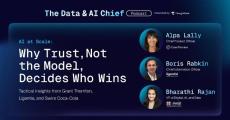
Every AI conversation eventually turns into a model conversation: which one is fastest, which one hallucinates least, which one your competitors are already using. Three recent episodes of The Data and AI Chief, hosted by ThoughtSpot's Chief Data and AI Strategy Officer Cindi Howson, make a different case entirely about what it takes to scale AI in the enterprise.

|
By Ivan Seow
On a recent All-In podcast episode, David Friedberg described how his team at plant-breeding company Ohalo Genetics spent a weekend building an internal CRM using Claude Code, Cursor, and a handful of other AI coding tools. They stood it up, started using it, and it worked. Then the requests started. Can you add this feature? Can it sync with the tools we already use? What about access controls and data security?
|
By Abhinav Singh
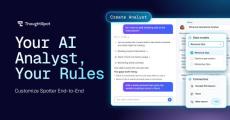
You can get an AI Analyst from most of the players, or you can try to build one yourself. Fewer let you decide what it knows, what it can touch, and who can use it. And even fewer still let you define what it won't do. You need all three before you hand one to a team or put one inside your product. In most of the product experiences, your AI analyst's context had two homes: one expert's head, or org-wide instructions.

|
By Sam Bowerman
Imagine hiring the sharpest analyst you have ever met. They know the industry cold. They reason like nobody else on the team. They write like a Nobel laureate. Then you realize you never gave them a badge, a laptop, or a login to the CRM. And a week later, nothing has shipped. Every task still routes back through you, because the analyst can think but can’t touch anything. You’ve just hired a very expensive conversation partner. That is most people's experience with AI agents today.
|
By Gopal Padmanaban
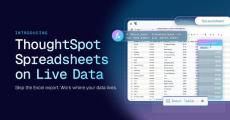
Every analyst has a version of this “Monday blues.” A leader pings asking for the quarterly forecast, wants it broken out by region, and needs it for a call in thirty minutes. The fastest way to do this? Pull the data out of your tool, paste it into Excel, and build the report there. Thirty minutes later, you've got the report: three new formula columns, a pivot view summarizing the regional split, and conditional formatting flagging the outliers.

|
By Laura Cohen
Most AI agents can write SQL. The problem is they write it against the wrong definition of revenue, for the wrong team, using the wrong business rules, and you won't catch that in a demo. Before you evaluate a single semantic layer vendor, there are four things worth getting right first. The semantic layer market has never been more crowded. Every major analytics vendor, data platform, and BI tool now claims to have one.

|
By Bhav Patel
You’ve rolled out a modern data stack, built self-service dashboards, and empowered your team to ask their own questions. Job done, right? Not quite. The data landscape is shifting rapidly beneath our feet, which makes it critical to understand how to build your AI for BI platform so you can scale and navigate technology evolutions.
|
By ThoughtSpot
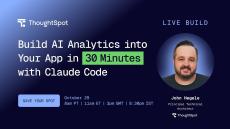
Embedded analytics in 30 minutes: watch us embed an AI analyst and branded analytics into an app with ThoughtSpot's SpotterCode in Claude Code. Live Thursday, October 29 8am PT · 11am ET · 3pm GMT · 8:30pm IST What you'll see: Every step is real code against ThoughtSpot's Visual Embed SDK and REST APIs. No ThoughtSpot experience needed. Speaker: John Hegele, Principal Technical Architect, ThoughtSpot.

|
By ThoughtSpot
Spotter answers from your data warehouse. The context behind those answers lives in the apps your team already uses, so we made connecting them a lot simpler with the Spotter connector marketplace, now GA in ThoughtSpot 26.10. In this walkthrough, you’ll learn how to.
|
By ThoughtSpot
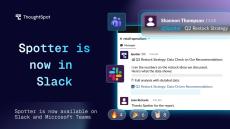
Most data questions come up in Slack. Most data answers require leaving it. In this demo, watch how Spotter, ThoughtSpot's AI analyst, works directly inside your Slack workspace, in direct messages, threads, and public channels. Ask a question in natural language, and Spotter pulls from your governed data models to return an answer with high-level insights and relevant artifacts (images, PDFs, and CSVs), right where the conversation is already happening.
|
By ThoughtSpot
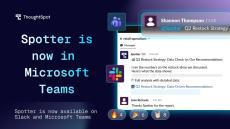
Your governed data is only useful if people can access it where decisions actually happen. For most teams, that's not a BI tool… it's Microsoft Teams. In this demo, watch how Spotter, ThoughtSpot's AI analyst, works directly inside Teams: in direct messages, group chats, and collaborative channels. Ask a question in natural language, and Spotter pulls from your governed data models to return an answer, right in the thread. Every answer names the model it came from, so anyone can verify the number instead of taking it on faith.

|
By ThoughtSpot
Why does context always seem to live in people's heads in enterprise organizations? According to Jessica Talisman, author of The Ontology Pipeline and founder of Contextually LLM, the answer is that organizations have invested heavily in data management for decades — and almost nothing in knowledge management. In this clip from Day 1 of our Semantic & Context Layer Series, Jessica joins Jane Smith and Sonny Rivera to untangle the terminology confusion around semantic layers, context layers, and memory and explain why the gap between data and knowledge is exactly where AI answers break down.

|
By ThoughtSpot
Even well-designed algorithms can fail and end up hurting the people they're meant to help. In this episode, Dr. Ben Green, Assistant Professor of Information and Public Policy at the University of Michigan, explains what keeps data from being used for good, why AI regulation can't be left to AI companies, and what organizations risk losing when they hand too much of their thinking to AI. In this clip from podcast, he shares why it is the companies that are building AI tools that need to be held responsible vs. putting agency on the tools.
|
By ThoughtSpot
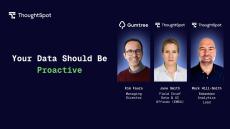
The bar for B2B software is being set by B2C experiences. In this clip, Kim Faura, former Managing Director at Gumtree, joins ThoughtSpot's Jane Smith and Mark Hill-Smith to talk about what this expectation shift means for product teams, and what it takes to close the gap between what B2B tools deliver today and what users now expect.
|
By ThoughtSpot
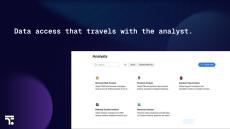
Before any data leader deploys an AI analyst, they ask the same question: what can it touch? In this video, see how Spotter Analysts are governed end to end. What you’ll see: → How admins control which certified models a Spotter Analyst can read→ How data access travels with a shared analyst→ How “show work” traces every answer back to its source→ What governed end to end means in a production agentic analytics environment.

|
By ThoughtSpot
Every campaign launch comes with the same overhead: write the brief, rewrite it for creative, rewrite it again for email ops, digital, and whoever else needs a version of it. Multiply that by every campaign your team runs, and weeks disappear before the work even starts. In this clip from the Thought Tank: Marketing in the Age of Agents, ThoughtSpot SVP Marketing EMEA Katie Marcham and CMO Micheline Nijmeh share the agent that changed that.

|
By ThoughtSpot
Marketing teams spend more time waiting on ops tickets to segment their database than they do actually running campaigns. By the time the segmentation comes back, the brief has changed, the moment has moved on, and someone is already asking for a revision. In this clip from the Thought Tank: Marketing in the Age of Agents, ThoughtSpot SVP Marketing EMEA Katie Marcham introduces the agent her team built to change that. They call it Slicy McSliceface, and it does exactly what the name suggests.

|
By ThoughtSpot
For more than 20 years, dashboards served as a foundational element of business intelligence, helping leaders visualize and share valuable data across their organization.
|
By ThoughtSpot
Businesses today run on apps, and those apps run on data. Too often, however, the technical complexity required to surface and explore that data for additional analysis prevents users from doing so. With ThoughtSpot Everywhere, organizations are easily building new data apps powered by the simplicity and ease of use of ThoughtSpot, or adding ThoughtSpot services to their existing SaaS offerings. This is giving them the unprecedented opportunity to create product experiences that stick, monetize data in new ways, and harness data right within existing tools.

|
By ThoughtSpot
Today, just 24% of organizations say they've succeeded at becoming data-driven.* This is a challenge many data leaders are still struggling to solve despite increasing demand for data-driven insights from business users. Migrating to a cloud data warehouse is a good first step-and many have done so-but introducing new technology is not the same as ensuring adoption. To truly reap the benefits of your cloud data warehouse investment, you need an equally fast, scalable, and easy-to-adopt analytics solution to make your cloud data available to all.

|
By ThoughtSpot
We are living in an unprecedented time driven by rapidly changing economic scenarios, the rise of digital native organizations and growing digital revolution, and the emergence of transformative business models. At the heart of much of this revolution is data. Organizations are collecting, analyzing, and mining data at an accelerated rate, creating new opportunities for powerful insights that deliver significant business impact.

|
By ThoughtSpot
Although making predictions about the future is difficult even under the best of circumstances, it's never been more important for business leaders to focus, prioritize, and act in order to stay ahead of the technological curve-and the competition. The strategies you used to innovate and grow your business in the past will not be the same ones you use today. Rethinking how you use data to react and proactively adapt to change will be critical to your bottom line.

|
By ThoughtSpot
Despite huge investments in data and analytics over the last two decades, many companies are still struggling with how to become truly data-driven. What are data leaders doing at the organizations that have figured it out? In this white paper, DATAcated Academy's Kate Strachnyi explores four key strategies for critically evaluating your entire data and analytics stack and systematically removing the barriers that exist between their business users and business-critical insights.
- October 2026 (20)
- September 2026 (26)
- August 2026 (21)
- July 2026 (15)
- June 2026 (16)
- May 2026 (15)
- April 2026 (13)
- March 2026 (15)
- February 2026 (15)
- January 2026 (28)
- December 2025 (17)
- November 2025 (17)
- October 2025 (13)
- September 2025 (14)
- August 2025 (6)
- July 2025 (6)
- June 2025 (6)
- May 2025 (2)
- April 2025 (5)
- March 2025 (6)
- January 2025 (3)
- December 2024 (4)
- November 2024 (6)
- October 2024 (3)
- September 2024 (1)
- June 2024 (4)
- May 2024 (1)
- April 2024 (4)
- March 2024 (3)
- February 2024 (3)
- January 2024 (11)
- December 2023 (2)
- November 2023 (6)
- October 2023 (8)
- September 2023 (11)
- August 2023 (15)
- July 2023 (4)
- June 2023 (16)
- May 2023 (14)
- April 2023 (5)
- March 2023 (16)
- February 2023 (4)
- January 2023 (7)
- December 2022 (8)
- November 2022 (4)
- October 2022 (16)
- September 2022 (11)
- August 2022 (18)
- July 2022 (3)
- June 2022 (7)
- May 2022 (9)
- April 2022 (6)
- March 2022 (6)
- February 2022 (6)
- January 2022 (12)
- December 2021 (6)
- November 2021 (13)
- October 2021 (5)
- September 2021 (13)
- August 2021 (14)
- July 2021 (8)
- June 2021 (13)
- May 2021 (16)
- April 2021 (8)
- March 2021 (5)
- October 2020 (1)
- January 2019 (2)
ThoughtSpot is the Modern Analytics Cloud company. With ThoughtSpot, you can put the full power of your modern data stack in the hands of every employee and customer with consumer-grade analytics.
Why Everyone Loves ThoughtSpot?
- Instant Insights for all: Stop waiting for custom reports from data experts and instantly answer ad-hoc data questions on the fly.
- Unleash the value of your cloud data: Maximize the value of your cloud data warehouse and accelerate speed-to-insight for everyone across your business.
- Build Interactive Data Apps: Drive adoption by embedding search and insight-driven actions into your apps using our low-code developer-friendly platform.
- Bye-bye backlog: Empower non-technical people to answer their own data questions, while you build a single source of truth with security and governance at scale.
Welcome to the Modern Analytics Cloud.