


|
By Lizzie Stokes
Starting Jan. 1, 2027, California will begin applying its sales tax to most software, including SaaS. Signed in June 2026, SB-122 closes a long-standing gap that left “digital products” in the state largely untaxed. Here’s how this impacts your public sector team.
|
By Lizzie Stokes
In just a few years, developers went from barely using AI to, at some companies, using it for nearly all of their code. As development cycles compressed, QA was pushed into its own AI revolution: AI-generated tests are increasingly seen as a mandate, the only way to keep up with how fast code now ships. And yet, not all AI-generated tests are created equal.

|
By Jason Secola
Quick summary: SAP Enterprise Performance Testing (EPT) by Tricentis now integrates with SAP Cloud ALM, so teams can create, run, and track performance tests in the same hub as the rest of their S/4HANA transformation. For teams managing SAP transformations, most major workstreams are visible in Cloud ALM, but performance testing has long been an exception. It has lived in a separate tool, forcing teams to treat it as a separate workflow that’s often left to the end of a project.
|
By Lizzie Stokes
Mike Dillon is a Global Platform Leader at IBM. While deeply technical and experienced in enterprise architecture, he is not a traditional hands-on software developer. Yet this spring, Dillon paired his domain expertise with IBM Bob, IBM’s AI coding assistant, to engineer his first full-scale enterprise application: WatsonAuditX. Designed to automate the documentation required for complex SAP audits, the app addresses a familiar operational roadblock.
|
By Sarah Welsh
In September, Anthropic’s CEO argued that AI companies should deliberately slow the pace at which they improve their models, because advances are outrunning researchers’ ability to understand and control them. Sam Altman endorsed the idea within hours, and other leaders of frontier AI labs quickly echoed him. For QE teams, the pace problem is already here. AI-generated change is arriving faster than anyone can review, and it isn’t arriving clean.

|
By Abigail Kurtzman
Not all AI transformations are equal, but when AI works well in quality engineering, the results are hard to ignore: 65% fewer major incidents, AI-generated test volume growing 6-7× in a year, or a five-step manual process replaced by three automated workflows. These are just a few of the outcomes from companies that moved past scattered AI experimentation to quality engineering that runs on a continuous, organization-wide signal.
|
By Annie Millerbernd
Oracle’s Fusion Agentic Applications represent a new class of enterprise software. They contain coordinated teams of outcome-driven, proactive AI agents that are engineered to execute business processes across finance, HR, supply chain, and customer experience. For folks who work in those departments, these agents may streamline some of their daily work and help uplevel employees. For testers, they bring a measure of ambiguity. In general, you know how humans use these applications.
|
By Eric Newcomer
By now everyone is aware of the limitations inherent in generative AI and the AI agents that use it to complete their tasks, and the challenges involved in getting them enterprise quality. If you are planning to incorporate AI agents into your enterprise IT architecture, how are you planning to validate their quality and accuracy?
|
By Tricentis Staff
For the first time ever, artificial intelligence has topped NASCIO’s annual ranking of state CIO priorities, ending cybersecurity’s 12-year reign at number one. It’s easy to see why: public agencies – like their private sector counterparts – see real potential in AI to modernize operations, accelerate service delivery, and help lean teams do more with fewer resources.
|
By Kateryna Gandzeichuk
Every AI headline this year is about speed: code shipping faster, test scripts generating in seconds, releases compressing from weeks to days. What gets less attention is what happens to quality when everything around it accelerates and the way you manage testing doesn’t.

|
By Tricentis
In this AI transformation roundtable, Nate Custer, Principal Technologist at TTC Global, shares how to measure productivity on an agentic quality engineering team. Drawing on a mainframe regression story, he explains why saving time only matters if you use it to close coverage gaps. He also argues that QA teams should track how often they have to fix AI-generated code, and why that measurement might mean more than speed or headcount.

|
By Tricentis
Someone opens a spreadsheet, pastes data from two systems side by side, and compares row by row, hoping to catch every error before it reaches production. In conversations with enterprises, nine out of ten still test data this way. In this short video, Adnan Ćosić, Senior Product Marketing Manager at Tricentis, explains why "stare and compare" and custom scripts can't keep up with modern data landscapes, and how Tricentis Data Integrity automates data testing end to end so you can trust every decision.

|
By Tricentis
Requirements change in Jira all the time, and QE teams have to catch every edit to update their test cases. Connect Tricentis AI Workspace agents to Jira and qTest, so any requirement change generates and updates test cases for you with the right context. In this walkthrough, Senior VP of Product Marketing Ryan Yackel, will show you how a Jira edit triggers an agentic workflow, pushes test requirements into qTest, and creates test cases with a human-in-the-loop checkpoint.

|
By Tricentis
Prompting your agentic IDE to write tests gives you different steps and different results every time. The result is inconsistent and low-quality test cases. Combine AI Workspace's agentic workflows with your Cursor IDE to generate a consistent, reusable test base straight from your code repository. In this walkthrough, Product Marketing SVP Ryan Yackel will show how Tricentis generates test cases from a GitHub repo, stores them in qTest, and runs tests against a desktop application.
|
By Tricentis
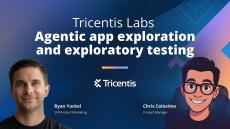
Modern applications move faster than traditional testing can keep up with. Teams inherit apps they did not build, ship on tight timelines, and release AI-generated code that no one has fully tested, so the gap between what gets built and what gets verified keeps growing.

|
By Tricentis
Going from a written requirement to an executable test usually means writing the steps and data yourself, then mapping each one to the application by hand. Pair Tricentis AI Workspace's requirement analysis with Tosca's agentic automation to go from a Jira ticket to a running, reusable test case for your SAP Fiori applications. In this walkthrough, you will see how to generate a test case from a requirement, map it to the Fiori UI, and save it for regression.
|
By Tricentis
Agents are easy to build and hard to measure. When your company runs hundreds or thousands of them, hand-written evals can’t keep up, and it’s unclear which agents are correct, efficient, and ready for users. In this conversation, Ryan Yackel, SVP of Product Marketing, and Andrew Demers, Product Manager for Agent Score at Tricentis Labs, explain how to measure agent quality, score agents automatically, and trace issues back to behavior.
|
By Tricentis
Most AI tools are designed as one assistant or co-pilot answering one prompt, but Tricentis Agentic Performance Testing is built differently. In this video, Product Marketing Manager Twan Koot explains the two pieces behind it: purpose-built tools and a team of seven specialized agents, each designed to do a performance tester’s job the way it should be done. Key highlights.

|
By Tricentis
Budgets are tight, AI is changing how software gets built, and citizens expect the same digital experience they get from their favorite online brands. One missed bug can put your mission and constituent trust at risk. In this video, John explains how public sector agencies can close the gap between speed and safety with automated software quality assurance. You'll see how the Tricentis platform helps teams decide what to test, manage testing in one place, automate end-to-end processes, and make sure systems perform under heavy load.
|
By Tricentis
SAP transformation projects are planned and tracked inside SAP Cloud ALM. Here's how SAP Enterprise Performance Testing by Tricentis, or EPT, brings performance testing into that same hub. In this demo, Tricentis walks through creating, running, and analyzing an EPT performance test without leaving SAP Cloud ALM, so performance problems surface long before go-live. Highlights.

|
By Tricentis
Build a modern testing practice with the Continuous Testing Framework, created by the world's leading testing experts.
|
By Tricentis
Continuous, automated software testing can save your business a huge amount of time and money, and prevent headaches down the line. But, depending on your organization's strategy, automation can create as many problems as it solves. Whether you're implementing test automation from scratch or already have a methodology in place, this eBook shares tips for optimizing test automation.
|
By Tricentis
Here's the simple truth: ServiceNow's digital workflows are only as effective as your release process allows them to be. This is why organizations have honed in on testing as a source of strategic advantage to help them release faster, improve the customer experience, and boost productivity.
|
By Tricentis
Maybe you've thought about changing your performance testing platform, but have a lot of fears: Will you waste money? Lose valuable time? Open your company up to risk? Change doesn't have to be scary. Read this eBook to learn five reasons why changing performance testing platforms shouldn't be frightening, and a few strategies to ensuring your migration is a success.
|
By Tricentis
For decades, the concept of artificial intelligence (AI) has captivated our imaginations - from science fiction and film to algorithms that can approximate conversation, to the predictive text programs that can produce new Harry Potter fan fiction today. AI is no longer a concept, it is real and here, leaving business leaders asking what it can do for their complex ERP systems like SAP? Read this white paper to learn.
|
By Tricentis
What do missions to space and ServiceNow releases have in common? More than you might think. Both involve many intricate moving parts that are vital for liftoff and mission success. Like the delayed NASA Psyche asteroid mission, insufficient testing can create significant impediments on the path to launch.
- October 2026 (23)
- September 2026 (10)
- August 2026 (7)
- July 2026 (6)
- June 2026 (12)
- May 2026 (6)
- April 2026 (6)
- March 2026 (9)
- February 2026 (6)
- January 2026 (4)
- December 2025 (6)
- November 2025 (4)
- October 2025 (4)
- September 2025 (6)
- August 2025 (4)
- July 2025 (6)
- June 2025 (5)
- May 2025 (3)
- April 2025 (13)
- March 2025 (3)
- February 2025 (5)
- January 2025 (6)
- December 2024 (6)
- November 2024 (4)
- October 2024 (6)
- September 2024 (2)
- August 2024 (16)
- July 2024 (2)
- June 2024 (3)
- May 2024 (4)
- April 2024 (4)
- March 2024 (11)
- February 2024 (11)
- January 2024 (8)
- December 2023 (1)
- November 2023 (3)
- October 2023 (5)
- September 2023 (4)
- August 2023 (3)
- July 2023 (2)
- June 2023 (7)
- May 2023 (3)
- April 2023 (3)
- March 2023 (1)
- February 2023 (5)
- January 2023 (7)
- December 2022 (3)
- November 2022 (3)
- October 2022 (11)
- September 2022 (7)
- August 2022 (13)
- July 2022 (2)
- June 2022 (2)
- May 2022 (2)
- April 2022 (1)
- March 2022 (3)
- February 2022 (2)
- November 2021 (6)
- April 2021 (1)
- January 2021 (1)
Enable everyone on your team to become a quality champion. The Tricentis platform accelerates testing of all your applications, data, and business processes and integrates with tools across your delivery pipeline.
Tricentis is the undisputed leader in enterprise test automation. We’re the only vendor in the category to achieve leader status in all the top analyst reports, including Gartner (5 years in a row), Forrester, and IDC. In every industry and geography, leading brands rely on Tricentis.
Continuous testing for digital businesses:
- Flexible and Scalable: Scale test automation across diverse teams, application types, and IT architectures.
- Codeless Options: Making it easy for non-technical business users and test engineers alike.
- AI-powered: Leveraging advanced ML technologies to enable faster, smarter testing.
Deliver quality software at DevOps speed.