Systems | Development | Analytics | API | Testing

Full Autonomy, Full Security: ClearML and SUSE k3k Bring Virtual Kubernetes Clusters to Enterprise AI

Kubernetes has become the de facto substrate for enterprise AI infrastructure. Its ability to handle complex, long-running workloads, self-healing capabilities, and rich ecosystem of GPU operators, storage drivers, and networking tools make it the natural platform for organizations scaling AI beyond the lab.

ClearML Introduces Floating NVIDIA AI Enterprise License Management with One-click NVIDIA NIM Deployments

ClearML has announced native floating license management for NVIDIA AI Enterprise licenses with one-click deployment of NVIDIA NIM microservices across AI infrastructure. The feature, available now to ClearML enterprise customers, fundamentally changes how organizations consume NVIDIA AI Enterprise software licenses, moving from a static per-GPU assignment model to a dynamic pool that follows active workloads.

ClearML Launches Platform Management Center to Bring Financial Clarity to Enterprise AI Infrastructure

At GTC 2026, ClearML announced the general availability of its Platform Management Center, an administrative dashboard purpose-built for IT administrators and AI platform leaders managing multi-tenant ClearML deployments at enterprise scale. Available under the ClearML Enterprise plan, it gives cluster admins a single place to monitor every tenant’s activity, resource usage, and costs while protecting the privacy of tenant workloads and data.

ClearML + NVIDIA Cosmos: ClearML Launches One Platform for NVIDIA Cosmos Deployment and the NVIDIA Video Search & Summarization Blueprint

ClearML’s out-of-the-box NVIDIA NIM integration brings NVIDIA Cosmos Reason 2 into production in minutes, providing the complete infrastructure, orchestration, vector database, and security stack to run NVIDIA Video Search & Summarization blueprint at enterprise scale.

How ClearML Helps Optimize Resource Allocation Across AI Workloads

Author: Adam Wolf Efficient resource allocation is a foundational requirement for scaling AI workloads, particularly as organizations move from isolated experiments to shared infrastructure supporting multiple teams, models, and environments. GPUs, CPUs, and high-performance storage are costly and finite, and without coordination, utilization often degrades as usage grows.

ClearML Enterprise v3.28: Usage Metering, Policy Enhancements, and Smarter Admin Controls

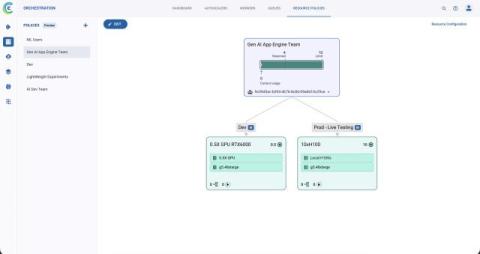
Author: Adam Wolf ClearML Enterprise v3.28 offers new features and improvements to help administrators monitor usage, enforce policies, and streamline operations across large, multi-team environments. This release introduces enhanced usage metering with a simplified interface, improved resource policy management, improved dataset controls, and UI enhancements to provide greater clarity, control, and productivity for AI teams.

Multi-Node Training with ClearML

Orchestrating distributed AI workloads Distributed (multi-node) training has become a requirement rather than an optimization for many modern AI workloads. As model sizes grow, datasets expand, and training timelines tighten, teams increasingly rely on multiple machines, often with multiple GPUs each, to complete training efficiently.

Why ClearML's AI Application Gateway is a Critical Layer for Secure, Scalable AI Development Environments

As organizations expand their AI initiatives, they increasingly need to provide users, be they data scientists, AI/ML engineers, researchers, or application developers, with secure access to interactive development environments such as JupyterLab, VS Code, or other internal tools.

Inside ClearML's AMD Instinct GPU Partitioning Integration: Architecture, Orchestration, and Resource Management

GPU underutilization costs enterprises millions annually, with expensive accelerators frequently running single workloads at a fraction of their capacity. According to ClearML’s 2025-2026 State of AI Infrastructure at Scale report, almost half (49.2%) of IT leaders at F1000 companies identified maximizing GPU efficiency across existing hardware, including shared compute and fractional GPUs, as their top priority for expanding AI infrastructure over the next 12-18 months.