Systems | Development | Analytics | API | Testing

ClearML Autoscaler: How It Works & Solves Problems

Sometimes the need for processing power you or your team requires is very high one day and very low another. Especially in machine learning environments, this is a common problem. One day a team might be training their models and the need for compute will be sky high, but other days they’ll be doing research and figuring out how to solve a specific problem, with only the need for a web browser and some coffee.

How to Use a Continual Learning Pipeline to Maintain High Performances of an AI Model in Production - Guest Blogpost

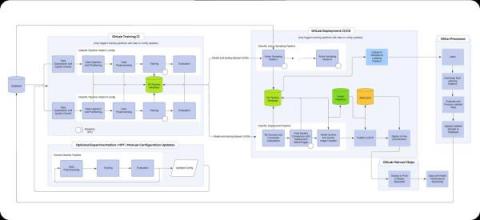
The algorithm team at WSC Sports faced a challenge. How could our computer vision model, that is working in a dynamic environment, maintain high quality results? Especially as in our case, new data may appear daily and be visually different from the already trained data. Bit of a head-scratcher right? Well, we’ve developed a system that is doing just that and showing exceptional results!

Cloud vendor's MLOps or Open source?

If someone had told my 15-years-ago self that I’d become a DevOps engineer, I’d have scratched my head and asked them to repeat that. Back then, of course, applications were either maintained on a dedicated server or (sigh!) installed on end-user machines with little control or flexibility. Today, these paradigms are essentially obsolete; cloud computing is ubiquitous and successful.

Growing AI Fast with ML-Ops: Breaking the barrier between research and production

AI models get smarter, more accurate, and therefore more useful over the course of their training on large datasets that have been painstakingly curated, often over a period of years. But in real-world applications, datasets start small. To design a new drug, for instance, researchers start by testing a compound and need to use the power of AI to predict the best possible permutation.

Building an MLOps infrastructure on OpenShift

Most data science projects don’t pass the PoC phase and hence never generate any business value. In 2019, Gartner estimated that “through 2022, only 20% of analytic insights will deliver business outcomes”. One of the main reasons for this is undoubtedly that data scientists often lack a clear vision of how to deploy their solutions into production, how to integrate them with existing systems and workflows and how to operate and maintain them.

Enabling distributed NLP research at SIL

In my main position, as a data scientist at SIL International, I work on expanding language possibilities with AI. Practically this includes applying recent advances in Natural Language Processing (NLP) to low resource and multilingual contexts. We work on things like spoken language identification, multilingual dialogue systems, machine translation, and translation quality estimation.