Systems | Development | Analytics | API | Testing

ClearML Enterprise v3.28: Usage Metering, Policy Enhancements, and Smarter Admin Controls

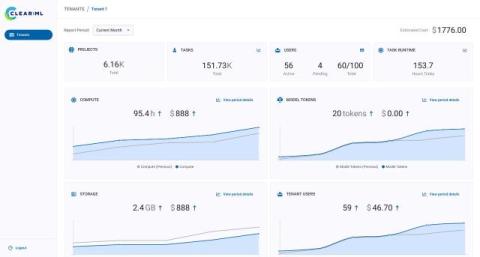
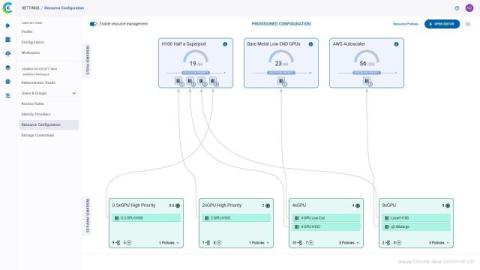
Author: Adam Wolf ClearML Enterprise v3.28 offers new features and improvements to help administrators monitor usage, enforce policies, and streamline operations across large, multi-team environments. This release introduces enhanced usage metering with a simplified interface, improved resource policy management, improved dataset controls, and UI enhancements to provide greater clarity, control, and productivity for AI teams.

Multi-Node Training with ClearML

Orchestrating distributed AI workloads Distributed (multi-node) training has become a requirement rather than an optimization for many modern AI workloads. As model sizes grow, datasets expand, and training timelines tighten, teams increasingly rely on multiple machines, often with multiple GPUs each, to complete training efficiently.

Why ClearML's AI Application Gateway is a Critical Layer for Secure, Scalable AI Development Environments

As organizations expand their AI initiatives, they increasingly need to provide users, be they data scientists, AI/ML engineers, researchers, or application developers, with secure access to interactive development environments such as JupyterLab, VS Code, or other internal tools.

7 RAG Evaluation Tools You Must Know

RAG evaluation measures how effectively a system retrieves relevant context and uses it to generate grounded answers. These evaluations detect hallucinations, measure retrieval precision and reveal where pipelines degrade after model updates or knowledge-base changes. Engineers rely on these tools to maintain output quality, prevent regressions, validate prompt and architecture choices and ensure that production answers stay aligned with trusted sources.

Inside ClearML's AMD Instinct GPU Partitioning Integration: Architecture, Orchestration, and Resource Management

GPU underutilization costs enterprises millions annually, with expensive accelerators frequently running single workloads at a fraction of their capacity. According to ClearML’s 2025-2026 State of AI Infrastructure at Scale report, almost half (49.2%) of IT leaders at F1000 companies identified maximizing GPU efficiency across existing hardware, including shared compute and fractional GPUs, as their top priority for expanding AI infrastructure over the next 12-18 months.

Run Slurm Workloads Inside Kubernetes With ClearML

By Erez Schnaider, Technical Product Marketing Manager, ClearML Slurm has powered HPC environments for years. It is battle tested, widely adopted, and deeply embedded in research and engineering workflows. Over 60% of the TOP500 supercomputers use it to manage their large infrastructure, orchestrate workloads and schedule jobs, as it is powerful and versatile with over 20 years of engineering behind it.

Introducing MLRun v1.10: New tools for building agents and monitoring gen AI

MLRun 1.10, the latest version of our open source AI orchestration framework, is available today to all users. Iguazio started out as a platform to operationalize enterprise machine learning projects. Though we’ve been through quite a few waves of AI in just a short time, the underlying challenges are the same: getting from experimentation to production remains a major blocker.

Banking on Gen AI: Driving Profitable and Scalable Client Engagement with Gen AI Copilots

Wealth management has always been about personal touch. Relationship managers provide a white-glove service to elite clientele - guiding investments, financial plans, and more. However, they’re under growing pressure to serve more clients and drive bank revenue, without diluting that personal connection and service quality. This dual mandate is placing relationship managers in a catch-22 situation. If they serve more clients their ability to provide personalized services diminishes, and vice versa.

LLM Observability Tools in 2025

1. Organizations have moved beyond pilots and are embedding LLMs into production workflows across customer support, finance, security, and software delivery. 2. LLM observability mitigates risks like hallucinations, bias, compliance breaches, and runaway costs. 3. LLM observability requires prompt/response tracking, hallucination detection, drift monitoring, RAG pipeline visibility, and long-term context tracing. 4.