
Systems | Development | Analytics | API | Testing

Connecting Apigee to GKE using headless services and Cloud DNS

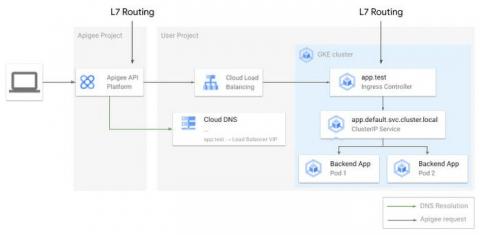
We’ve recently supported an organization who wanted to expose its Google Kubernetes Engine (GKE) backend behind Apigee X. A quite common architecture, which most of the users delivering modern web applications on Google Cloud tend to build upon. In this scenario, Google’s API gateway, Apigee, receives requests and performs L7 routing, redirecting you to the correct backend application, running as one or more pods on GKE.

Sponsored Post

How to Test Microservices in Kubernetes

In this article, you will learn about some of the tools to test microservices running in a Kubernetes cluster. In particular, we will compare the Speedscale CLI tool with other tools and the main benefits of using Speedscale CLI. In the last few years, software companies have been shifting from building monolith applications to utilizing smaller microservices. In a microservices architecture, you operate with decentralized applications. This means that there's a separation in which each service is responsible for a specific component of your application.

Kong Inc. supports the newly announced Envoy Gateway project to reduce fragmentation in the Envoy ecosystem

Today, the Envoy community has introduced Envoy Gateway, a new project to better support Kubernetes deployments via the new Kubernetes Gateway API, which is the next generation Ingress specification in Kubernetes world. Kong has been deeply invested in the success of Envoy since we started developing Kuma in 2019 – now used in Kong Mesh (built on top of Kuma).

Understanding the new Kubernetes Gateway API vs Ingress

Kubernetes Ingress is one of the most widely used resources across Kubernetes. It helps to expose your applications and services to the outside world. However, the networking landscape in Kubernetes has significantly evolved. Many modern use cases very quickly exposed the limitations of Ingress API. This led to the creation of the Gateway API, a collection of new resources and APIs which improve and will potentially supersede Ingress in the future. What does this mean for you? Join us and learn everything you need to know about what Gateway API brings to the future of Kubernetes networking.
Sponsored Post

Kubernetes Load Test Tutorial

In this blog post we use podtato-head to demonstrate how to load test kubernetes microservices and how Speedscale can help understand the relationships between them. No, that's not a typo, podtato-head is an example microservices app from the CNCF Technical Advisory Group for Application Delivery, along with instructions on how to deploy it in numerous different ways. There are more than 10 delivery examples, you will surely learn something by going through the project. We liked it so much we forked the repo to contribute our improvements.

Kong API Gateway on Kubernetes with Pulumi

The quest for resilience and agility has driven us into the modern age of microservices. Bringing services to market on a microservice architecture demands utilization of sprawling technology offerings and tooling. While daunting at first glance, we can break down the process into 3 major categories: In this hands on series, we will use.

Orchestrating ML Pipelines at Scale with Kubeflow

Still waiting for ML training to be over? Tired of running experiments manually? Not sure how to reproduce results? Wasting too much of your time on devops and data wrangling? Spending lots of time tinkering around with data science is okay if you’re a hobbyist, but data science models are meant to be incorporated into real business applications. Businesses won’t invest in data science if they don’t see a positive ROI.