
Systems | Development | Analytics | API | Testing

What Happens When the CEO Can Always Get the Answer

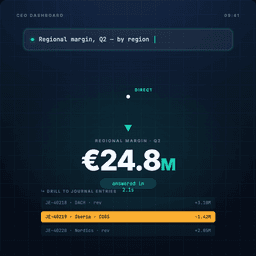
The goal is not complicated to describe. The CEO opens a dashboard, asks a question about regional margin for Q2, drills through to the underlying journal entries, and gets the answer in seconds, without asking anyone. No email to the controller. No waiting until Thursday. No 'let me come back to you on that.' Every CFO who has sat through a pitch for a data platform has been shown this vision. Most of them believe it is achievable. A meaningful number have actually achieved it.

Why Your Best Finance Analysts Are Leaving

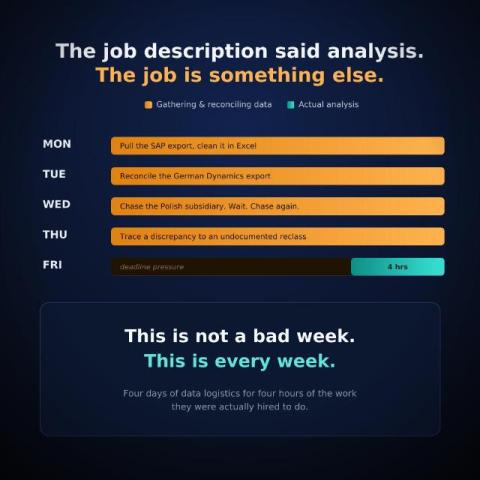
It is Monday morning. Your strongest FP&A analyst opens their laptop and starts pulling the SAP export. They clean it in Excel, cross-reference it against last month's version, and flag the columns that have shifted format again. Tuesday they pull the Dynamics export from the German entity and begin reconciling the two. Wednesday the Polish subsidiary data has not arrived. They chase the local accountant, wait, chase again.

The First Deadline Nobody Warns You About

You are forty-eight hours into the role. The acquisition has closed. The press release went out. The operating partner has sent a congratulatory message and a list of reporting expectations. And somewhere in a credit agreement you are still reading, there is a covenant reporting deadline. It is in 45 days. It requires auditable numbers from a business you have not yet fully seen, running on systems you do not yet control, with a finance team you have not yet met.

Why Your Chart of Accounts Breaks at Every Acquisition

You closed the deal. The press release went out. Integration planning is underway. And somewhere in the finance team, a controller is opening a spreadsheet and starting to map 1,400 account codes from the acquired company's ERP into your group chart of accounts. This is the moment the chart of accounts breaks. Not dramatically. Not all at once.

Why Your Rolling Forecast Is Always Stale

Every FP&A team knows the feeling. The reforecast was published on Monday. By Wednesday, someone in sales has closed a deal that changes the revenue picture. By Friday, procurement has flagged a cost overrun that nobody modelled. The forecast is four days old and already partially wrong. This is not a forecasting problem. It is a data pipeline problem. Finance teams hired analysts for their analytical skills.

Guessing AI vs. Verifiable AI: Why the Difference Matters in Finance

I asked Claude what the cash position would be at year-end. The answer was about 30% off. A CFO said this at a finance leaders breakfast in Prague. Almost every CFO in the room had a version of the same story. The problem is not the model. Claude is not bad at maths. The problem is what the model was reasoning over - raw financial data with no governed definitions, no intercompany rules, no agreed methodology for what 'cash position' means at that specific company.

The Numbers You Can't Trust: Why multi-entity finance has a data problem - and what CFOs are doing about it.

The board asks a question. You know the answer, roughly. But "roughly" is not what you say in a board meeting. So you confirm later. Three days later, the board has moved on. This is not a knowledge problem. It is a data infrastructure problem. This whitepaper is about that problem, and the CFOs who fixed it without replacing a single ERP.

From 50 Spreadsheets to One Source of Truth

The acquisition closed on Friday. The new CFO walks in on Monday morning. Within 48 hours, the Operating Partner sends a message: when do we get the first financials? The CFO opens their laptop and starts counting. Six ERPs. Three different chart of accounts structures. Two businesses that still report in spreadsheets emailed to a shared inbox. One entity whose close cycle runs two weeks behind the others. This is not a failure of diligence or talent.

The PE CFO Playbook: Your First 100 Days, Data-First

You close. The lenders want a covenant report in 45 days. Your finance team is running on spreadsheets, three ERPs, and a shared folder nobody has cleaned since 2019. This playbook is the week-by-week plan for exactly that moment — written for incoming CFOs, interim CFOs, and the Operating Partners who place them.