
Systems | Development | Analytics | API | Testing

AI Assisted Development Explainer

AI is transforming software development, but it can be costly and hard to maintain without clear direction. Appian addresses this with spec-driven development: use AI to extract business logic and create visual, collaborative specifications. Then, let agents build and update apps with alignment and control, optionally integrating external agentic tools, so critical applications are built to last.

Appian Q3 Release Highlights: AI Speed Meets Enterprise Controls

AI is evolving faster than organizations can keep up, and often it’s the most important operations that fall the furthest behind. That’s exactly why Appian is focused on AI for complex, enterprise-grade processes—to make applying AI automation to important work easy. Over the last quarter, Appian has continued to invest in capabilities that help you deploy AI fast without sacrificing control: Over 80% of developers regularly use AI coding tools.

Intelligent Document Processing Platform: 4 Must-Have Features for 2027

An intelligent document processing (IDP) platform uses AI technologies to automatically capture, classify, extract, validate, and route data from unstructured documents such as invoices, contracts, emails, PDFs, or even hand-written scans. As organizations continue to adopt AI into their daily workstreams, IDP is on track to shift from a back-office efficiency tool to a core component of enterprise AI automation.

Human Judgment Is the Missing Variable in Your AI Strategy

Across teams, organizations, and industries, people are starting with AI instead of the problem they want to solve. As a result, AI outputs from different tools: This is a process failure, and it's accelerating. Human-in-the-loop (HITL) AI is a framework that integrates human oversight directly into the machine learning lifecycle. Rather than relying on fully autonomous systems, HITL uses humans and machines collaboratively to train models, evaluate outputs, and handle complex decision-making.

Data Integration in the Life Sciences: Eliminate Data Silos for Good

In the life sciences industry, where breakthroughs in research and healthcare are fueled by data, data silos can be a big problem. Data silos might be caused by things like legacy systems, departmental divisions, disparate data formats, or lack of interoperability standards. Data silos can manifest at any point in the product lifecycle and make it hard for the right people to access and use the information they need, when they need it.

AI Transformation in Financial Services: Sandeep Dubbireddi on Speed, Control & Explainability

AI transformation in financial services is no longer just a technical upgrade—it is the cornerstone of delivering the seamless digital experiences today's banking and insurance customers demand. In this feature from Appian Around the World London and Appian Europe, Sandeep Dubbireddi, Industry Vice President of Financial Services at Appian, breaks down what it takes to successfully diffuse artificial intelligence across entire enterprise organizations.

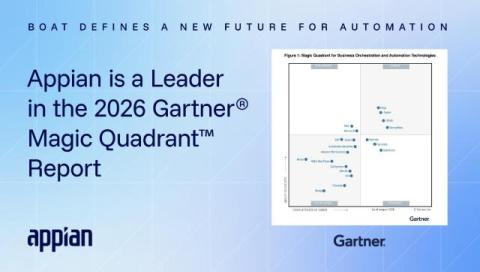
BOAT Defines a New Future for Automation: Appian is a Leader in the 2026 Gartner Magic Quadrant Report

Over the past few decades of digital transformation, organizations have accumulated separate tools for separate jobs: RPA for UI automation, BPM for workflow management, iPaaS for API integrations, and other point solutions. These investments have delivered undeniable productivity gains. But they've also created challenges: systems that don’t talk to each other, processes that break across integrations, and IT teams that spend more time maintaining the technology rather than innovating with it.

Best Practices for Modernizing Your Payment Investigation Process with AI

AI agents are proliferating faster than most institutions can govern them and the primary challenge is quickly becoming an "accountability gap." Disconnected pilots rarely scale into accountable, auditable operations. The financial services industry is currently at a tipping point: banks must bridge the gap between initial AI enthusiasm and operational reality.