Systems | Development | Analytics | API | Testing

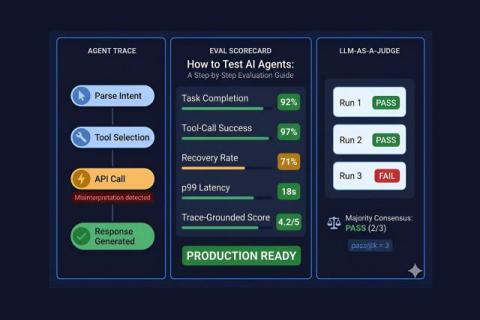
How to Test AI Agents: A Step-by-Step Evaluation Guide

Testing an AI agent means validating more than final outputs — it means auditing every intermediate tool call, reasoning step, and context decision the agent makes across its full execution trace. Unlike traditional software testing, where passing means the right function returned the right value, agent testing must verify that the correct sequence of decisions produced a reliable outcome for a non-deterministic system.

How to Choose the Right Test Automation Framework in 2026

Picking the wrong test automation framework is a decision that compounds over time. Choose based on your team's stack, not industry hype. Before committing to any framework, run a proof of concept against your actual CI/CD pipeline, not a demo environment. Choosing a test automation framework used to feel like picking a car: there were a few obvious options, most people picked the most popular one, and you lived with the consequences. In 2026, the landscape looks more like a fleet decision.

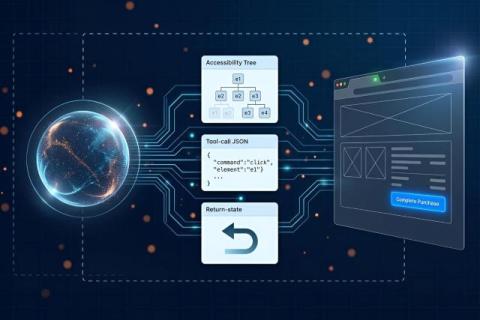
Playwright Test Agents & MCP: A 2026 Architecture Guide

Playwright test agents are LLM-driven execution loops that wrap Playwright's browser automation in a goal-oriented reasoning layer. Instead of executing pre-written scripts, an agent receives high-level intent ("complete checkout and verify the success modal"), inspects the page's accessibility tree, and chooses which Playwright tool to invoke next. The Model Context Protocol (MCP) is the standardized bridge that exposes Playwright capabilities to the LLM and returns structured page context back.

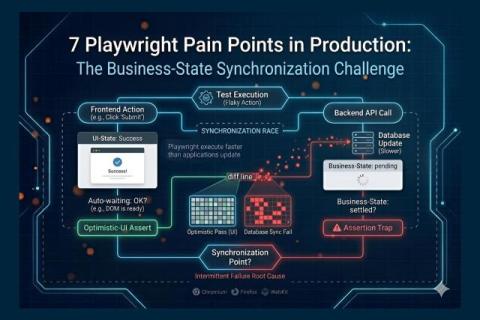
The 7 Playwright Pain Points Engineers Hit in Production (2026)

Playwright is the standard for modern browser automation in 2026. It provides superior execution speed, native auto-waiting, and deep browser context control. However, running any automation framework at enterprise scale exposes operational friction. When engineering teams move from local execution to continuous integration, they encounter a consistent set of playwright pain points that the framework's official documentation rarely surfaces clearly.

Playwright Visual Regression Testing: A Production Guide to Baselines, Flake, and CI

Native Playwright visual regression is free to start and expensive to scale. The cost shows up in CI, not on day one. Cross-OS rendering breaks pixel diffs: Windows, macOS, and Linux render fonts and spacing differently, so the same code produces different baselines on different machines. Component snapshots beat full-page captures: smaller scope means clearer failure signal, fewer timeouts, and less flake on asset-heavy pages.

Playwright Flaky Tests: The 2026 Fix Playbook

Five diagnostic patterns. One decision tree. A senior practitioner's triage playbook for Playwright flakiness in 2026. Flakiness is architectural, not framework-borne: Almost every flake traces back to async state, locator drift, session pollution, environment variance, or AI-agent non-determinism — not to Playwright itself.

Agentic Testing and QA: Why Chrome DevTools Still Matters for Modern Testers

Chrome DevTools is the built-in browser inspector and debugger that ships with Google Chrome, giving testers ground-truth visibility into DOM state, network traffic, device rendering, and runtime behavior. In the context of Agentic Testing and QA — the emerging pattern where AI agents draft, execute, and summarize tests with reduced human supervision — DevTools remains the verification layer that confirms what an agent actually did inside the browser.

Agentic Testing and QA: A 90-Day Playwright Learning Roadmap

A 90-day Agentic Testing and QA roadmap is a structured learning plan that combines daily JavaScript and TypeScript practice with hands-on Playwright automation and AI-assisted testing skills. It is built around three 30-day phases — language fundamentals, Playwright fundamentals, and advanced framework plus AI-oriented work — and assumes about one hour of practice per day.

Gherkin vs Traditional Testing: Which One Wins with AI?

Gherkin's structured, human-readable format gives it a decisive edge when working with AI-powered testing tools. Start evaluating your test suite structure now, as AI-powered QA is becoming the industry standard, and your test format determines how well these tools can assist you. The debate over Gherkin vs traditional testing has taken an unexpected turn.