Systems | Development | Analytics | API | Testing

Leveraging AI For a Better API Strategy

“API strategy” is a term prominently established in the ecosystem and heavily discussed, implemented, and followed by organizations. The term is more relevant now since API strategy has become, for the most part, AI strategy, since AI agents and services are now consuming APIs and tools to work towards business-specific goals under human tutelage. So the longstanding definition and scope of API strategy must take into account AI consumers.

Featured Post

Unlocking Innovation with the API Economy

As the technology stacks utilised by modern businesses grow increasingly complex, so does the number of integrated applications that are required to work together. The key enablers of this collaboration are Application Programming Interfaces (APIs), which act as the "glue" between applications, machines and databases, and let the different elements of an organisation's system work together as one cohesive whole.

The Role of Integration in the Agentic Enterprise

In this episode of, *Steve Jordan* and *Shafreen Anfar* from WSO2 explore how integration is paving the way for the agentic enterprise, where humans and AI agents collaborate to drive business success. They discuss how seamless connectivity across systems provides agents with the real-time context and ability to take action that is necessary to scale AI from simple pilots to full-scale production. The conversation also highlights the importance of robust security, governance, and observability in managing this new digital workforce.

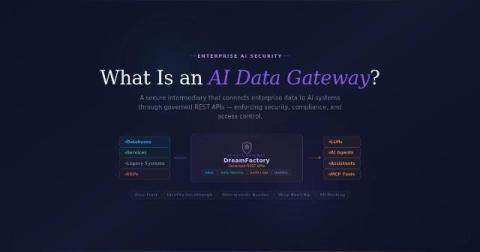
What is an AI Data Gateway? | DreamFactory

An AI Data Gateway is a secure intermediary that connects enterprise data sources (like databases and file systems) with AI systems. It simplifies how AI accesses data while enforcing strict security, compliance, and governance measures. Instead of allowing direct access to sensitive data, the gateway uses secure REST APIs to control and monitor all interactions.

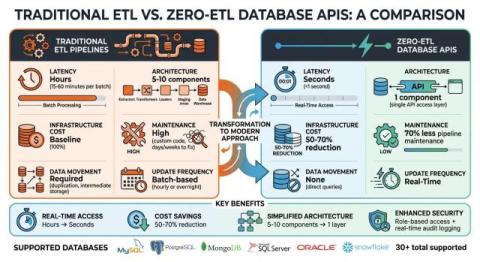
Zero-ETL Database APIs: Live Data Without Data Movement | DreamFactory

Zero-ETL Database APIs let you access live data instantly without needing traditional ETL processes. Instead of extracting, transforming, and loading data, these APIs query databases directly in real-time, significantly reducing delays that can span hours. Key features include federated querying (accessing multiple data sources simultaneously) and schema-on-read (applying schemas dynamically during queries).

Prompt, Deploy, Pray Is Dead: Validating AI Code with Proxymock

Recent outages tied to AI-assisted code changes have pushed companies into a corner. After several incidents with massive “blast radius” impacts, organizations like Amazon introduced stricter controls—mandating that senior engineers manually review all AI-generated code before it hits production. That response makes sense on paper, but it exposes a fatal flaw in the modern development pipeline.

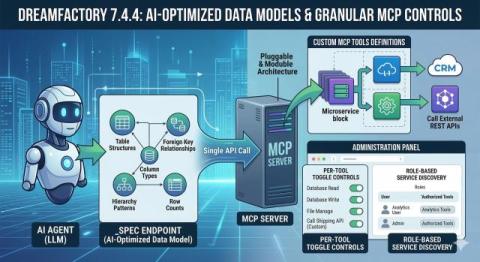
DreamFactory 7.4.4 Release: AI-Optimized Data Models, Custom MCP Tools, and Granular Access Controls

DreamFactory 7.4.4 is a significant release for teams connecting AI agents to enterprise databases through the Model Context Protocol (MCP). The new _spec endpoint gives LLMs a complete understanding of any database schema in a single API call. Custom MCP tool definitions let admins extend their MCP server beyond built-in database operations. And new per-tool toggle controls with role-based service discovery bring the governance enterprises need before deploying AI-database integrations to production.

The European Health Data Space (EHDS): From Regulation to Reality

The European healthcare landscape is undergoing its most significant digital transformation in decades. We are moving away from a fragmented era where health data was locked within the walls of individual hospitals and national borders. In its place, the European Health Data Space (EHDS) is emerging, a unified digital ecosystem designed to give patients control over their data and unleash its potential for research and innovation.

Best AI test automation tools for fast, high-quality releases

The promise of test automation was simple: automate repetitive testing tasks, catch bugs faster, and ship quality software at scale. Yet for most development teams, that promise remains unfulfilled. Traditional test automation frameworks demand specialized coding skills, require constant maintenance when applications change, and create bottlenecks that slow down release cycles rather than accelerate them.