Systems | Development | Analytics | API | Testing

Kong Gets a New Look with Electric Agentic-Era Rebrand

We're pulling back the curtain on a project we've been working on for some time now: the next evolution of the Kong brand. You may have noticed some changes recently to our site, swag, or socials. But today it's official: we're announcing Kong's rebrand and introducing our new mascot, Karl. Without further ado, let's dig in. Along the way, we'll give some insight into the "why" behind it all, while looking back at how things have changed since the early days of Kong. We were the API connectivity company.

Kong and Straiker: Runtime Security and Agent-Level Control for AI Agents

Kong AI Gateway already gives platform teams a central place to route, observe, and enforce policy across AI traffic. Security teams working alongside those platform teams often need another set of answers: Which agents are connected? Which attack paths actually succeed against them? What happened across the full session or tool chain? And if an agent is compromised, can its next action be stopped before it reaches an enterprise system? The integration is designed to be complementary.

Kong named a Leader in the Forrester Wave for API Management, Q3 2026

Kong is named **a Leader** in *The Forrester Wave: API Management Software, Q3 2026*. APIs used to be about connecting systems to each other. Now they're also how AI agents connect to everything: tools, data, other agents. That shift changes what good API management looks like, and it's where we at Kong have shifted our focus. Forrester's take on where we land.

Your Multi-Agent System Is Only as Reliable as Its Context Layer

You've mapped the architecture. You know your agents need to retrieve context from external tools, coordinate with other agents, and propagate mutations through your systems. The model logic is solid. What you haven't fully solved is what sits between those agents and everything they're trying to reach. That's the gap Kong was built to close. Multi-agent workflows live and die on context.

The Architecture Decision Your Multi-Agent System Will Live With

Most teams building multi-agent systems hit the same wall at roughly the same point. The prototype works. Agents chain together, tasks complete, the demo impresses the room. Then someone asks: "What happens when this runs a thousand times a day? What happens when an agent calls an external API that's down? How do we know what the agents actually did?" That's when the architecture conversation starts. Here's the framing that clarifies most of these questions.

Kong AI Gateway Applies NVIDIA NeMo Switchyard Across Model Traffic

Every team running production LLMs has had the same idea: not every request needs the frontier model. Intelligent model routing (or LLM routing)— choosing a model per request on criteria such as task complexity, cost, latency, or quality — enables more efficient model usage.

What Are AI Agents Actually Doing When They Talk to Each Other?

You've probably seen the demos. An AI model kicks off a task, hands pieces of it to other AI models, and somehow the whole thing gets done. Emails drafted, code reviewed, reports summarized — all without a human in the loop. While a single agent doing one thing is impressive, the true paradigm shift occurs when transitioning from single-agent to multi-agent AI systems. It looks like magic. It isn't.

A New Dawn: Enterprise AI's Shadow - Trillions of Tokens, Zero Governance

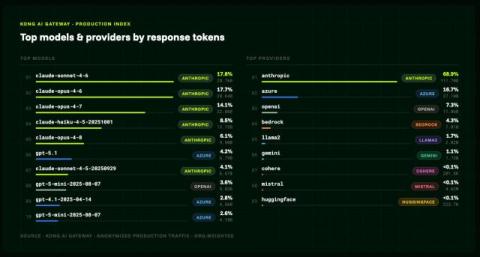
You Can't Govern What You Can't See A decade ago, cloud and API sprawl got ahead of governance, and enterprises spent years trying to account for costs they'd never tracked. Today, we're seeing the same pattern around AI, with hundreds of customers proxying traffic via Kong AI Gateway, which includes LLM, MCP, and agent connectivity. *AI spending will reach $2.59 trillion in 2026.* I regularly like to share what we're seeing in production at Kong.

Stop Patching. Start Building: The Kong Context Mesh Stack

You've diagnosed the problem. Your agentic AI initiatives are stalling — not because the models are wrong, but because the integration layer underneath them wasn't built for this. Batch data, rigid schemas, fragmented governance, no real-time event delivery. Now the question is: what do you actually build, and how do you build it without tearing down the infrastructure you already have?