
Systems | Development | Analytics | API | Testing

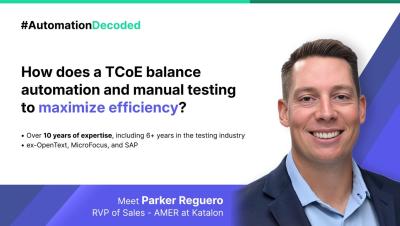
How does a TCoE balance automation and manual testing to maximize efficiency?

A TCoE should automate the repeatable, detail-heavy regression checks to remove human error and speed releases, while keeping room for manual testing where judgment matters or ROI is low. Automate execution to free the team to focus on new functionality and high-value scripts, and leave fringe or one-off cases manual so effort pays off. — Parker Reguero, RVP of Sales at Katalon Learn more Follow Katalon for more insights in our series!

How can we make test automation more accessible to non-technical stakeholders?

The way to make automation accessible is to simplify three things for everyone creating tests running tests and analyzing results. Let non technical teammates run existing suites on demand and use smarter analysis including AI to surface who what why quickly so leaders and support can see what is broken without pulling in engineers. — Philip Becker, Sr. Product Manager at Katalon Learn more Follow Katalon for more insights in our series!

Does automation reduce the need for skilled manual testers, or are they still essential?

Automation does not replace skilled manual testers. You start by exploring the app as a human to understand how it behaves, then automate those steps with low code, record and playback, code, or a mix. Automation brings speed while manual skill brings insight. Use both to form a complete testing strategy. — Alex Martins, VP of Strategy at Katalon Learn more Follow Katalon for more insights in our series!

How can automated testing enhance developer-tester collaboration in Agile development?

Automated tests act as a shared, code-based language for testers and developers. They make what is being tested explicit and turn failures into clear signals with details like missing locators, browser logs, and network data. Looking at the same artifact builds connection and speeds fixes in Agile teams. — Coty Rosenblath, CTO at Katalon Learn more Follow Katalon for more insights in our series!

What are the trade-offs between using open-source tools and a commercial solution?

Open source brings real power, but its goals may not match your organization. Look at community health, whether it fits your use case, and how you will handle support, updates, and patches. Consider the integrations your stack requires. Weigh these against a commercial platform that offers formal support, a roadmap, and hosted infrastructure to reduce your maintenance burden. — Coty Rosenblath, CTO at Katalon.

What key factors to consider when choosing between open-source and commercial testing tools?

Community viability and integrations decide a lot when choosing between open source and commercial tools. Check whether the open source project’s community is large, active, and aligned with your use case. Verify that required integrations for your enterprise stack are supported. Consider long-term maintenance risk if a project is abandoned versus the sustained support and roadmap you get from a viable vendor.

Does automation reduce the need for skilled manual testers or are they still essential?

Automation does not replace skilled manual testers. Testers decide what to test and design effective cases while automation handles repeatable checks so teams keep up with demand. Keep progressing by automating previous work so new features get attention. — Philip Becker, Sr.

What are the primary objectives of manual testing compared to test automation?

Alex Martins, Katalon's VP of Strategy, explains that manual testing confirms application correctness through human checks, while test automation runs fast, repeatable regression tests to catch unintended changes and save time and cost. Follow Katalon for more insights in our series!