Systems | Development | Analytics | API | Testing

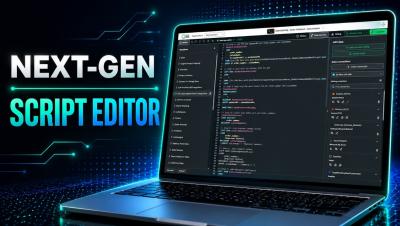
Qlik Script Editor Gets a Major Upgrade

Qlik Cloud just introduced a modern, IDE-grade editing experience for the Data Load Editor and Script Editor — now available in Public Preview. In this video, Michael Tarallo walks through what's new, including dark mode, improved syntax highlighting, code folding, smarter navigation, autocomplete, and code refactoring with Rename Symbol. Learn how to activate the Next-Gen Script Editor in your tenant and see how these updates make everyday Qlik scripting faster and more intuitive.
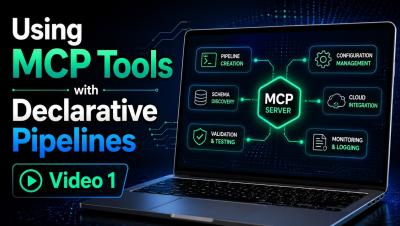
Using MCP Tools for Declarative Pipelines - Video 1

This is Part 1 of a two-part video series exploring how Qlik MCP tools can be used with declarative pipelines directly within VS Code. In this video, I demonstrate how to use the MCP tools to explore and validate your Qlik environment before building anything—identifying available connections, inspecting source tables, reviewing pipeline project information, and verifying the resources you plan to use.

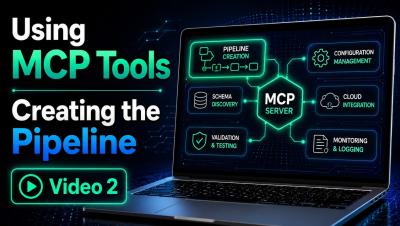
Using MCP Tools for Declarative Pipelines - Creating the Data Pipeline - Video 2

This is Part 2 of a two-part video series exploring how Qlik MCP tools can be used with declarative pipelines directly within VS Code. In this video, Mike Tarallo, demonstrates how to now create the data pipeline using declarative YAML in VS Code. You will see the creation process, learn some tips and tricks and see the final result.

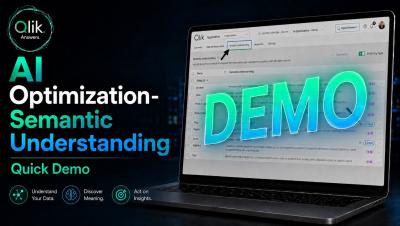
AI Optimization - Semantic Understanding - Quick Demo

AI Optimization is a workspace for managing how Qlik Answers understands an application. It brings semantic management into one experience, where you can review AI-generated semantic understanding and make corrections before they reach an answer. The result is a visible, correctable layer where there used to be none. AI Optimization is the central place to manage how Qlik Answers interprets your application. Semantic Understanding, inside it, shows and lets you edit this interpretation of each field and master item.

Agentic AI Just Rewrote the Data Engineer's Job Description. Here's What IT Leaders Need to Know.

Gartner predicts that 70% of today's data engineering tasks will be fully automated by 2030. I put that number to Tim Garrod, Qlik's Head of Product Management for data integration and quality, on a recent Qlik Insider session, and his answer is the one every CIO, CDO, and VP of IT should sit with: automation doesn't make the data engineer obsolete, it makes the good ones ten times more valuable. AI amplifies skilled judgment. It doesn't replace it.

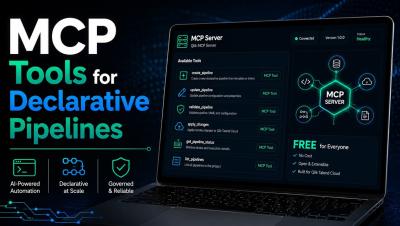
New MCP tools for Declarative Pipelines

Qlik's MCP server just got three new lookup tools built for data engineering. They connect directly to your Qlik Cloud tenant, so coding agents can pull the real project values a pipeline needs instead of working from an empty template, find spaces and data connections by name, and browse the tables and views available on a connection, just by asking in natural language. That means easier declarative pipeline creation, with real tenant context built right into your prompt for faster, more accurate iteration.

From Intent to Data Product: Pipelines, Agents & MCP

The challenge for most data teams isn’t a lack of ideas—it’s the time it takes to turn those ideas into something usable. In this session, Steffen Bischoff, Chief Architect Data at Qlik, follows a single dataset from a core system through its entire journey to becoming a governed data product. You’ll see pipelines created by describing intent instead of writing code, versioned in Git, then curated, quality-checked, and documented with the help of specialized agents. From there, the data product is made available to the AI tool of your choice through the Qlik MCP Server.

The Times They Are A-Changin' - Just Not on SAP's Terms

Bob Dylan wrote those words in 1964 about a world in flux - where the old rules were being quietly rewritten, and the people who hadn't noticed yet were about to find out the hard way. He wasn't thinking about enterprise data architecture. But if you've been following SAP's moves on data access, extraction, and platform strategy over the past two years, those words might be landing a little closer to home than usual.