Systems | Development | Analytics | API | Testing

From Intent to Data Product: Pipelines, Agents & MCP

The challenge for most data teams isn’t a lack of ideas—it’s the time it takes to turn those ideas into something usable. In this session, Steffen Bischoff, Chief Architect Data at Qlik, follows a single dataset from a core system through its entire journey to becoming a governed data product. You’ll see pipelines created by describing intent instead of writing code, versioned in Git, then curated, quality-checked, and documented with the help of specialized agents. From there, the data product is made available to the AI tool of your choice through the Qlik MCP Server.

The Times They Are A-Changin' - Just Not on SAP's Terms

Bob Dylan wrote those words in 1964 about a world in flux - where the old rules were being quietly rewritten, and the people who hadn't noticed yet were about to find out the hard way. He wasn't thinking about enterprise data architecture. But if you've been following SAP's moves on data access, extraction, and platform strategy over the past two years, those words might be landing a little closer to home than usual.

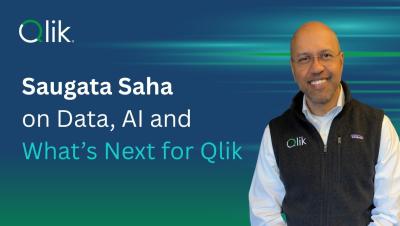
Saugata Saha on Data, AI, and What's Next for Qlik

Qlik’s new CEO discusses why he joined the company, the opportunity he sees at the intersection of data and AI, and what customers and partners can expect from his leadership. Qlik CEO Saugata Saha recently sat down with Jessica Dubois, Senior Director of Global Tech Partners, for his first external conversation since joining the company.

Saugata Saha on Data, AI, and What's Next for Qlik

Qlik CEO Saugata Saha sits down with Jessica DuBois, Senior Director of Global Tech Partners, for his first external conversation since joining the company. Saugata discusses what drew him to Qlik, the opportunity he sees at the intersection of data and AI, and why bringing increasingly capable AI together with trusted, governed data remains one of the most important challenges facing organizations today.

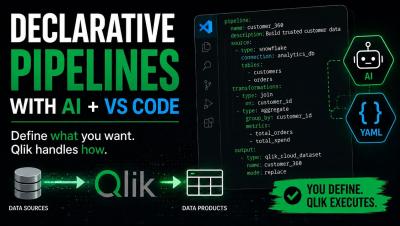
Qlik Declarative Pipelines with AI and VS Code

Managing your data pipelines shouldn't mean leaving the tools you already work in. In this video, Qlik Solution Architect, Joe Easley, shows how Qlik's declarative pipelines let you build and manage your integration ecosystem right alongside your own LLM and IDE — no switching platforms, no extra UI to learn. The benefit: faster iteration, fewer handoffs, and pipelines that live where your code already does.

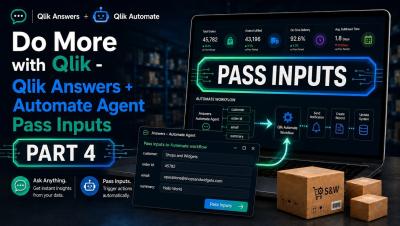
Qlik Answers and the Automate Agent - Using Inputs - part 4

In this video, Mike Tarallo shows you a simple Qlik Automate workflow with defined inputs, then uses the Automate Agent in Qlik Answers to pass those inputs directly into the automation. This demonstrates how users can move beyond simply asking questions and begin taking action based on their data—all from a conversational experience. You’ll see how Qlik Answers and Qlik Automate work together to turn natural-language requests into real, automated workflows with minimal setup.

Unlocking the Power of Trusted Data Intelligence: Amazon Quick Meets Qlik MCP Server

When was the last time you made a major business decision and were completely certain the data behind it was accurate, complete, and trusted? For most organizations, that certainty is less common than it should be. Qlik and Amazon Quick together solve one of the biggest obstacles to AI adoption: knowing whether you can trust the output.

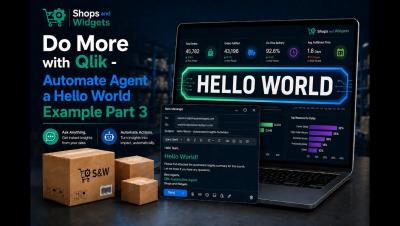
Qlik Answers and the Automate Agent - Hello World - Part 3

In Part 3, we keep things simple with a “Hello World” example that shows how to create a basic Qlik Automate workflow and trigger it directly from Qlik Answers. You’ll see how an insight can quickly become an action—all within Qlik, without a complicated setup. Check out Parts 1 and 2 for the full series.

Beyond the Budget: The AI Decisions That Only Humans Can Make

Earlier this month I spent time with a group of senior executives discussing the economics of AI: what it actually costs, where the value is and is not materialising, and what the organisations that are getting returns are doing differently from the ones that are not. That conversation encapsulates why this series is called Beyond the Budget. Not because cost does not matter. It does. But because the budget is where the consequences show up.