Systems | Development | Analytics | API | Testing

The latest News and Information on Software Testing and related technologies.

Stop testing everything: How Tricentis SeaLights tells you exactly what to test

Most teams don't know which parts of their code have actually been tested, and which haven't. That gap is where defects escape. Tricentis SeaLights is a quality intelligence platform that gives engineering and QA teams real-time visibility into test coverage. It maps every code change to the tests that cover it, surfaces exactly what's tested and what isn't, and recommends which tests to run and which to skip across unit, regression, integration, manual, and end-to-end tests.

Perforce Autonomous Testing: One Test, Total Coverage

What if testing could finally keep up with your release speed? With Perforce Autonomous Testing, teams can simply describe what they want to validate, and AI takes care of execution, orchestration, and analysis across functional and performance testing. Built on a unified testing platform, Perforce brings everything together into a single workflow to eliminate manual setup, reduce reliance on specialists, and deliver faster, in-sprint feedback.

Why Your D365 Test Automation Strategy Needs a Rethink Before May 2027

If you’re running Microsoft Dynamics 365 and relying on RSAT (Regression Suite Automation Tool) to keep your test automation ticking, there’s a deadline you cannot afford to ignore: RSAT support ends on 15 May 2027. That’s not far away, and the decisions you make now will shape how painlessly your QA practice survives the transition. So let’s talk about what comes next and why the answer is more interesting than you might expect.

Safeguarding Multi-Brand E-Commerce: Architectural Quality Engineering for Enterprise Scale

When you operate a digital commerce ecosystem across multiple international borders, processing thousands of concurrent checkout events for over 70 global brands, the standard concept of "QA" completely breaks down. Most corporate discussions treat software validation as a simple pre-release checklist, a final mechanical hurdle before a deployment goes live.

Which Bugs AI Agents Fix Better With Traffic

In the first experiment, I wanted a baseline: if an AI coding agent gets the same production signal a human would get, can it fix bugs in a codebase it has never seen? Yes, but only when I gave it better context. With only an alert, the agent passed 51% of the runtime tests. When I added captured traffic, the actual request and response for the failing call, it climbed to 77%. This post is the second pass.

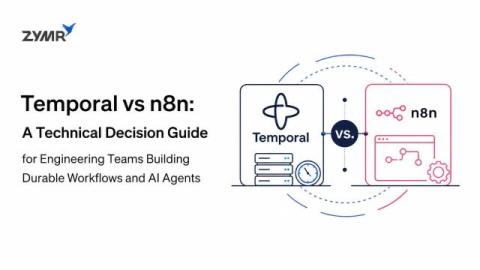
Temporal vs n8n: A Technical Decision Guide for Engineering Teams Building Durable Workflows and AI Agents

If you have watched a Temporal demo and an n8n demo back to back, the reaction is almost universal: “Wait, aren’t these the same thing?” Both stitch together a sequence of steps. Both retry failures. Both, as of 2026, market themselves around AI agents. On a whiteboard, they look like cousins. They are not. Temporal vs n8n is one of the most common false equivalences in modern engineering, and getting it wrong is expensive in both directions.

AI Load Testing With a French LLM: OctoPerf MCP Meets Mistral Vibe

When we released the OctoPerf MCP Server, most teams connected to it straight from Claude.ai. Then we showed how to run the whole stack on-premise with a local model. But a question kept coming back from European teams: can we drive our load tests with a French LLM, hosted in Europe, instead of a US model? The answer is yes, and it takes about five minutes.

Rendezvous Points: Simulating Real Simultaneity, Not Just a Ramp-Up

This is the fourth post in our "Features Sitting Idle" series, where we explore OctoPerf features that are powerful, already available, and yet often replaced by manual workarounds. The distinction matters, and it is often overlooked in test scenarios. Teams that need to simulate a true simultaneous spike - flash sales, ticket drops, mass logins at a specific time, scheduled batch openings - usually end up working around the problem instead of using the tool's native support for it.