Systems | Development | Analytics | API | Testing

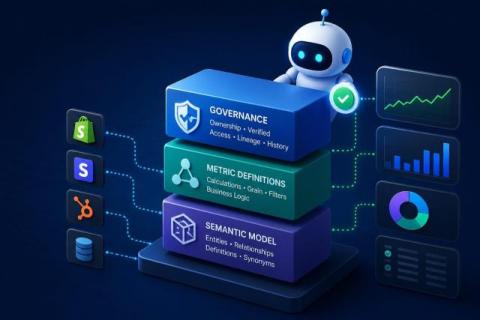
Why AI Agents Need a Semantic Layer (and What That Actually Means in 2026)

Everyone is racing to put an AI agent on top of their data. Almost nobody is asking whether the agent can be trusted to act on what it sees. That is the wrong order. And the way most teams are trying to fix it — bigger context windows, more reasoning, another eval — is also wrong. The generative model stopped being the hard part of agentic analytics months ago. Wiring an LLM to a warehouse is a weekend project.

AI agent streaming in action: barge-in, human handover, and session continuity

You're mid-conversation with an AI support agent. You've explained the problem, the agent is halfway through a response, and the connection drops. When you reconnect, the response is gone. You type the same question again. The agent asks the same clarifying questions again. Three minutes of context, gone. Not because the model forgot it, but because the delivery layer stored nothing.

The Big AI Lie

Shub Agarwal (Founder of the AI Trust Lab at USC) flips the script. Stop over-investing in massive data overhauls. Instead, reverse your approach: start with a brutal business problem, pull only the specific data needed to solve it, and build incrementally. Chief Data & AI Strategy Officer Cindi Howson agrees that true value comes from scaling immediate business impact, not waiting for a flawless architecture that will never arrive.

When AI Infrastructure Meets Enterprise Data: ClearML on the Dell AI Data Platform

Dell Technologies has published a validated integration of ClearML with the Dell AI Data Platform (AIDP), pairing ClearML’s AI infrastructure capabilities with Dell’s enterprise-managed storage and search engines. The result is a reference architecture that lets AI teams keep moving fast while platform teams keep the data foundation enterprise-grade. Here is what the integration does, why it matters, and where it fits.

Why Healthcare Organizations Need Governed AI Analytics

For healthcare organizations, AI governance is a must-have that can’t be ignored. To safeguard sensitive patient information, healthcare is subject to a variety of different regulations, for example HIPAA in the United States and GDPR in the European Union. As healthcare organizations implement AI, it brings a balance of efficiencies and risks.

Perforce P4 vs Git for AI Coding Agents: Why Parallel Development Hits a Merge Wall

A few months ago, a CTO I respect posted on LinkedIn that he was thinking about going back to Perforce P4 or SVN. He runs a modern engineering org and uses Git. The trigger was that his AI coding agents were stomping on each other’s changes faster than his developers could reconcile them. That post isn’t an outlier. It’s an emerging pain point in AI-driven workflows.