
Systems | Development | Analytics | API | Testing

CMS Interoperability : Reimagining Prior Authorization with Conversational AI

Prior authorization has long been one of healthcare’s most time-consuming and costly administrative processes, creating friction between payers, providers, and patients. Manual data entry, back-and-forth faxes, and complex coverage rules often delay care delivery and frustrate both clinicians and members. In this webinar, we'll explore how conversational AI — combined with FHIR-based interoperability, contextual understanding, and an agentic approach — can revolutionize the prior authorization process. Discover how AI-driven, human-like interactions can transform prior authorization into a seamless, intelligent workflow.


Introducing the Kong MCP Registry: Connect AI Agents with the Right Tools

In the rapidly evolving landscape of AI-driven development, the Model Context Protocol (MCP) has emerged as the critical standard for connecting AI applications to the data and tools they need. We are excited to announce the Technical Preview (TP) of Kong MCP Registry, a major milestone in our mission to provide the most comprehensive platform for modern API and AI management.

Connect Your Local AI Model to Enterprise Databases with DreamFactory: A Real-World Integration Story

A mid-sized enterprise had a straightforward but powerful idea: use their locally-hosted AI model to automatically generate summaries of employee performance review data stored in their SQL Server database. The workflow seemed simple enough: The reality? This "simple" integration touches on some of the thorniest problems in enterprise software: database security, API orchestration, authentication, timeout management, and reliable data transformation.

Migrate from Postman to Insomnia: Free Collaboration for Unlimited Users

With Valentine’s Day fast approaching, love is in the air. And apparently, so are breakup emails. This isn’t just about one pricing change. It’s about a pattern. Some tools promise “free forever” to get you invested, watch you build workflows, and then change the rules. They know you’ve onboarded your teams, documented your APIs, and integrated the tool into your daily work. By the time they spring the paid tier on you, switching feels painful.

Top 6 automated testing tools for enterprise scalability

Scaling test automation from hundreds to thousands of tests introduces challenges underestimate. Maintenance overhead compounds as UI changes ripple through test suites. Parallel execution becomes essential but complex to orchestrate. Enterprise applications like SAP, Salesforce, and Oracle demand specialized testing approaches.

Agentic AI Governance: Managing Shadow AI and Risk for Competitive Advantage

While every organization races to deploy AI agents faster, a quieter crisis is compounding in the background, and it will play a large part in determining who survives the agentic era. The numbers are stark. Too many executives see AI governance as a brake on innovation or something to figure out later, after the speed problem is solved. With agentic AI, that's backwards.

Agentic AI Cost Management: Stopping Margin Erosion and the Fragmentation Tax

While every organization races to deploy AI agents faster, finance departments are watching something alarming unfold—and it will play a large part in determining who survives the agentic era. The numbers are stark: 84% of companies report more than 6% gross margin erosion from AI costs. Within that, 26% report erosion of 16% or more. And only 15% of companies can forecast AI costs within ±10% accuracy—the majority miss by 11-25%, and nearly one in four miss by more than 50%.

Refactor Safely with AI: Using MCP and Traffic Replay to Validate Code Changes

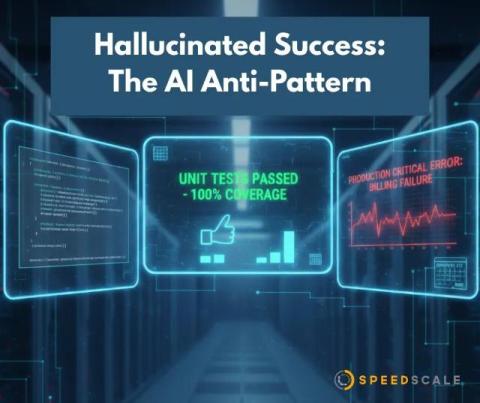
So as software engineers using AI coding assistants, we’re quickly learning of a new anti-pattern: Hallucinated Success. You give your agent (e.g. Claude via terminal or various IDE code assistants) the command “refactor the billing controller.” The agent happily complies, churning out nice clean code. The agent even goes so far as to write a new unit test suite that passes at 100%. You integrate it. Your test suites pass. Your production code breaks. Why?