
Systems | Development | Analytics | API | Testing

Is self-service BI attainable? Benefits and historical concerns of self-service BI

Whether you call it self-service analytics or self-service business intelligence (BI), there has been much discussion about the perils, myths, promises, and prospects of successfully building self-service capability. Going forward, I’ll use the phrase “self-service BI” but you are welcome to substitute the words “self-service analytics”.So, is self-service BI actually attainable or just snake oil?

How Doordash Brings Data Analytics to Everyone With Snowflake And Alteryx

In this interview with Ryan Green on “Data Cloud Now,” Adam Wilson and Nitin Brahmankar of Alteryx outline their company’s mission to move data from the realm of the highly technical and into the hands of the people in in organizations who actually use the data to unlock insights, manage risk, cultivate markets, and more. It’s a mission, they says, that is helped along by the ecosystem of Snowflake users who work as a community to solve customer use cases. #datacloudnow #datacloudworldtour

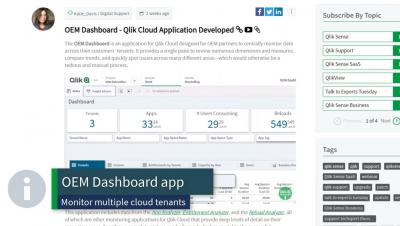
SaaS in 60 - Qlik Sense SaaS - Monitoring Apps

Did you know that Qlik offers a variety of monitoring applications that can provide various insights on your Qlik Cloud environment? If you want to track usage capacity of users on your tenant, check out the Entitlement Analyzer. Need to optimize your Qlik Sense applications? Then perhaps the App Analyzer will help. Want more insight into your app reloads – download the Reload Analyzer.

Ozone Write Pipeline V2 with Ratis Streaming

Cloudera has been working on Apache Ozone, an open-source project to develop a highly scalable, highly available, strongly consistent distributed object store. Ozone is able to scale to billions of objects and hundreds petabytes of data. It enables cloud-native applications to store and process mass amounts of data in a hybrid multi-cloud environment and on premises.

Modern Data Architectures | Data Mesh, Data Fabric, & Data Lakehouse

For years, companies have viewed data the wrong way. They see it as the byproduct of a business interaction and this data often ends up collecting dust in centralized silos governed by data teams who lack the expertize to understand its true value. Cloudera is ushering in a new era of data architecture by allowing experts to organize and manage their own data at the source. Data mesh brings all your domains together so each team can benefit from each other’s data.

Using Snowpark For Python And XGBoost To Run 200 Forecasts In 10 Minutes

Snowpark for Python, now generally available, empowers the growing Python community of data scientists, data engineers, and developers to build secure and scalable data pipelines and machine learning (ML) workflows directly within Snowflake—taking advantage of Snowflake’s performance, elasticity, and security benefits, which are critical for production workloads. Using user-defined table functions (UDTFs) and the new Snowpark-optimized warehouse with higher memory, users can run large-scale model training workloads using popular open-source libraries available through Anaconda integration.

Snowpark for Python: Large-Scale Feature Engineering, Machine Learning Model Training, and More

As data science and machine learning adoption has grown over the last few years, Python is catching up to SQL in popularity within the world of data processing. SQL and Python are both powerful on their own, but their value in modern analytics is highest when they work together.

Developers Rejoice! Snowflake Is All in on Python, Pipelines, and Apps

Snowflake is committed to helping developers focus on building their apps and businesses rather than on infrastructure management. At this year’s Snowday, Snowflake announced a series of advancements that empower developers to do more with their data, enhancing productivity and unlocking new ways to develop applications, pipelines, and machine learning (ML) models with Snowflake’s unified data platform.