Systems | Development | Analytics | API | Testing

News Analysis 2026: How Emerging Cloud Testing Standards Are Reshaping Performance Testing

On June 25, 2026, new cloud testing standards were formally announced, establishing a unified baseline for validating performance, security, and compliance in cloud environments worldwide. These standards are the result of years of technological advancement and an industry-wide push for more rigorous, repeatable validation methods as cloud architectures have grown increasingly complex.

Best test management tools for enterprises

Enterprise testing tools often fail at the same point: the testing setup that worked for one team starts straining under ten teams, multiple pipelines, and an audit request tied to the same release. The core question becomes where testing should live as complexity grows. For some organizations, testing belongs inside Jira, where developers, product, and QA already work.

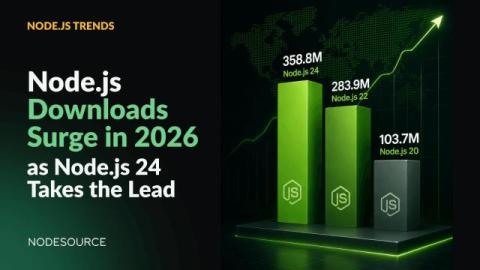
Node.js Downloads Surge in 2026 as Node.js 24 Takes the Lead

2026 is shaping up to be a remarkable year for Node.js download activity. Through July, downloads recorded through the official Node.js distribution infrastructure have already surpassed the total recorded during all of 2025: 4.61 billion downloads in the first seven months of 2026, compared with 4.48 billion across the entire previous year. That puts 2026 roughly 128 million downloads ahead of the 2025 total, with five months still left in the year. Figure 1.

Break One Dependency, Not The Whole Cluster

Scoped chaos rules are now in proxymock. A filter query picks the traffic, an effect perturbs it, and every response that gets touched is labelled so you can tell an injected failure from a real one for the rest of the run. Available in v2.5.892 and newer. The short version of why: kill a pod and you learn something real, but you do not learn what your service does when a dependency stays up and starts lying to it.

Application Level Dependency Chaos Testing

Somewhere in your service is a branch that has never executed. Not a rare one, a never one. It handles a dependency being unavailable: it reads from a cache, it returns a stale value, it marks the response degraded so callers know not to trust it too far. It was written carefully. It was reviewed. Whether it works is an open question, because nothing in the test suite makes that dependency fail, and the dependency does not fail on request.

The EU's New AI Transparency Rules and What They Touch in PropTech

AI adoption across multifamily and PropTech has outpaced the rules meant to govern it, and one of those rules is now in force. On August 2, 2026, the transparency obligations under Article 50 of the EU AI Act began to apply, setting specific requirements for how certain AI systems interact with people and how AI-generated content is marked and disclosed.

BFSI Software Testing: How Quality Engineering Builds Secure and Reliable Financial Applications

Financial applications leave little room for failure. A delayed payment, an inaccurate transaction, an exposed customer record, or a failed banking integration can quickly become a business and customer-trust issue. This is why BFSI software testing needs to go beyond checking whether individual features work. Financial platforms bring together sensitive data, payment workflows, banking APIs, authentication systems, databases, and customer-facing interfaces.

9 Low-Cost SaaS Metrics & KPI Dashboard Tools That Are Ridiculously Easy to Set Up

The best SaaS metrics dashboard software doesn’t have to cost enterprise money. Every tool on this list is priced for growing companies, sets up without a demo call, and pulls your key metrics out of the apps where they’re trapped. If you’re a SaaS company specifically, we’ve built a dedicated home for this problem: see how Databox works as the best SaaS metrics dashboard software for finance, product, and go-to-market data.

Top Healthcare Interoperability Companies to Know in 2026

The healthcare interoperability vendors 2026 buyers are evaluating enable secure data exchange across providers, payers, patients, and digital health platforms. Their solutions connect fragmented systems through Fast Healthcare Interoperability Resources (FHIR) APIs, Health Level Seven (HL7) interfaces, identity matching, and terminology mapping. Vendor selection is critical because most Centers for Medicare & Medicaid Services (CMS) CMS-0057-F API requirements begin in January 2027.