
Systems | Development | Analytics | API | Testing

Build Embedded AI Analytics with Claude Code in 30 Min | LiveBuild | ThoughtSpot

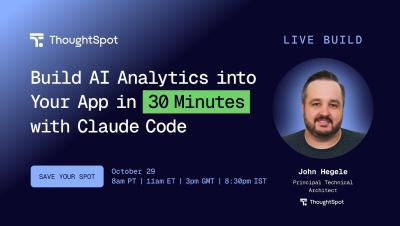
Embedded analytics in 30 minutes: watch us embed an AI analyst and branded analytics into an app with ThoughtSpot's SpotterCode in Claude Code. Live Thursday, October 29 8am PT · 11am ET · 3pm GMT · 8:30pm IST What you'll see: Every step is real code against ThoughtSpot's Visual Embed SDK and REST APIs. No ThoughtSpot experience needed. Speaker: John Hegele, Principal Technical Architect, ThoughtSpot.

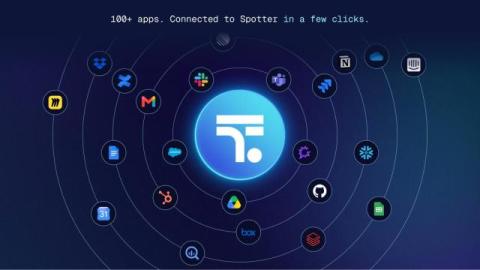
Connect Spotter to the Apps Where Your Team Gets Work Done

Your data warehouse can tell you that pipeline dropped. It can't tell you why, because the reason sits in a sales call, a support ticket, or a thread in your team chat. When your AI analyst can't reach those places, you end up doing the last mile yourself: copying numbers into Slack, pasting call notes into a doc, and switching tabs until the story makes sense. Spotter could already connect to any MCP server, but getting one in place meant hunting for a server URL and digging through setup docs.

Your AI Analyst Is Now in Slack: Here's How It Works

Most data questions come up in Slack. Most data answers require leaving it. In this demo, watch how Spotter, ThoughtSpot's AI analyst, works directly inside your Slack workspace, in direct messages, threads, and public channels. Ask a question in natural language, and Spotter pulls from your governed data models to return an answer with high-level insights and relevant artifacts (images, PDFs, and CSVs), right where the conversation is already happening.

Your AI Analyst Is Now in Microsoft Teams: Here's How It Works

Your governed data is only useful if people can access it where decisions actually happen. For most teams, that's not a BI tool… it's Microsoft Teams. In this demo, watch how Spotter, ThoughtSpot's AI analyst, works directly inside Teams: in direct messages, group chats, and collaborative channels. Ask a question in natural language, and Spotter pulls from your governed data models to return an answer, right in the thread. Every answer names the model it came from, so anyone can verify the number instead of taking it on faith.

Spotter Is Now Available in Slack and Microsoft Teams

Let’s say a regional sales director posts a soft renewal number in the channel. A teammate asks the question that decides the plan: trend, or seasonal blip? Nobody in the thread can answer, so the thread does what threads do. It moves on, and the plan gets anchored to the most confident opinion in the room. The maddening part: the data existed. It was modeled, governed, correct, sitting in the warehouse the whole time. It's not a data problem; the answer was there.

The Security Domino Effect: Why Trust Can't Be an Afterthought in AI

In interconnected software environments, a security vulnerability rarely exists in isolation. A weakness in one component can expose credentials, create unintended access paths, or give attackers a foothold in connected services. The consequences depend on what that component can access, the permissions it holds, and the safeguards around it. As organizations adopt cloud platforms, third-party integrations, and AI-powered development tools, the boundaries between systems matter more than ever.

AI at Scale: Why Trust, Not the Model, Decides Who Wins

Every AI conversation eventually turns into a model conversation: which one is fastest, which one hallucinates least, which one your competitors are already using. Three recent episodes of The Data and AI Chief, hosted by ThoughtSpot's Chief Data and AI Strategy Officer Cindi Howson, make a different case entirely about what it takes to scale AI in the enterprise.

Why Enterprise AI Context Lives in People's Heads, and How to Fix It

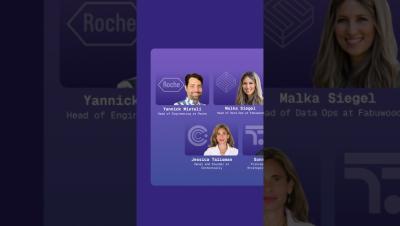
Why does context always seem to live in people's heads in enterprise organizations? According to Jessica Talisman, author of The Ontology Pipeline and founder of Contextually LLM, the answer is that organizations have invested heavily in data management for decades — and almost nothing in knowledge management. In this clip from Day 1 of our Semantic & Context Layer Series, Jessica joins Jane Smith and Sonny Rivera to untangle the terminology confusion around semantic layers, context layers, and memory and explain why the gap between data and knowledge is exactly where AI answers break down.

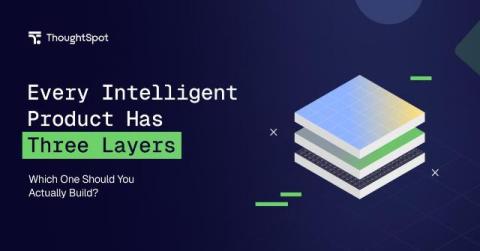
Introducing the Three-Layer Model for Intelligent Products

On a recent All-In podcast episode, David Friedberg described how his team at plant-breeding company Ohalo Genetics spent a weekend building an internal CRM using Claude Code, Cursor, and a handful of other AI coding tools. They stood it up, started using it, and it worked. Then the requests started. Can you add this feature? Can it sync with the tools we already use? What about access controls and data security?