
Systems | Development | Analytics | API | Testing

ClearML Supports Seamless Orchestration and Infrastructure Management for Kubernetes, Slurm, PBS, and Bare Metal

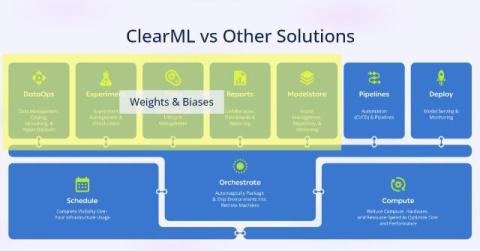
Our early roadmap in 2024 has been largely focused on improving orchestration and compute infrastructure management capabilities. Last month we released a Resource Allocation Policy Management Control Center with a new, streamlined UI to help teams visualize their compute infrastructure and understand which users have access to what resources.

Mission to Mars: Building NASA's Digital Twin with Helix Core and Unreal Engine

Did you know that digital twins – built with the help of Perforce Helix Core and Unreal Engine – help propel astronauts to space? In this webinar, Ryan Maffesoli, Senior Solutions engineer at Perforce, Greg Porter, Senior Systems Architect at Sev1Tech, and Marc Aubanel, Director of Digital Media Arts & Engineering at LSU, explore this exciting process.

GenAI: Navigating the Risks That Come with Change

For enterprises, commercial use of AI is still in its early stages, and it’s a case of risk and reward, weighing up both and investigating the best way forward. Of course, there’s much to gain from the use of AI. Already, companies are providing better customer service, parsing complex information through natural language inputs, and generally making workflows faster.

Running Solid Queue in production Rails apps

Background jobs are essential to many Ruby on Rails apps. Since the introduction of ActiveJob, Rails developers have been able to manage their background jobs as natively as they do their database records. Still, ActiveJob requires you to select (and support) a backend adapter that will implement ActiveJob's backend. Many use Redis, a memory cache, to queue and process background jobs. Redis comes with incredible speed but is yet another dependency to maintain.

Accelerating Deployments of Streaming Pipelines - Announcing Data in Motion on Kubernetes

Organizations are challenged today to become both more data driven and more nimble to adapt quickly to changing conditions. These challenges are the driving forces behind much of their digital transformation or “modernization” efforts.

Digital Transformation in Aviation Industry: What's your take?

Airports are now heavily inclined towards integrating self-baggage drop facilities to ensure a hassle-free experience and eliminate long-standing queues. Plus, some airports are also introducing smart baggage trolleys to help passengers locate wherever they want to go at just their fingertips. Well, these are just a few of the innovations in the Aviation industry because the list is never-ending. Nevertheless, did you know that the airports using this new technology have seen some amazing results?