Systems | Development | Analytics | API | Testing

How is Agentic AI rewriting Retail Banking?

Your customers are no longer comparing you to the bank down the street. They are comparing you to Amazon, Netflix, and every hyper-personalized digital experience they interact with daily. And most banks are losing that comparison. Quite literally! Somewhere between the legacy core systems, the compliance overhead, and the quarterly earnings pressure, a tectonic shift has started. Agentic AI is no longer a concept in a research paper.

Inside NERSC at Berkeley Lab: How a DOE Office of Science User Facility Is Exploring ClearML for Scientific AI Workflows

NERSC, the mission high-performance computing center for the U.S. Department of Energy Office of Science, is using ClearML as part of the AI infrastructure stack for Perlmutter, the upcoming Doudna supercomputer, and the broader American Science Cloud. Here is a look at what they are exploring and why it matters for AI for science at scale.

Generative AI for QA: How SDET Workflows and Skills Are Changing

Generative AI for QA is the use of large language models to accelerate the creation and analysis of testing artifacts — drafting test cases, summarizing requirements, and generating synthetic test data. AI agents extend that capability into multi-step autonomous workflows that plan, delegate, and execute testing tasks across an entire delivery pipeline. For SDETs, the shift is not about learning to prompt more cleverly.

Human in the Loop Testing: Where AI Ends and QA Judgment Begins

The question isn't whether to use AI in QA. It's knowing exactly where to keep a human in control. The core risk: Over 75% of multi-agent failures are silent semantic errors that pass automated checks but violate business logic — detectable only by human inspection (Cemri, Pan et al., NeurIPS 2025). The division of labor: AI owns repetitive generation and execution; humans own risk analysis, requirement interpretation, exploratory investigation, and final sign-off. The operational discipline.

How We Used Agentic AI to Fix Kong Gateway's Flakiest Tests

Each change to Kong Gateway's codebase triggers a comprehensive test suite that runs more than 17,000 * 2 = 34,000 test cases among the two primary architectures (x86 and ARM) we support. This process takes about 23.5 hours on a single machine. But we don't wait that long. A large fleet of machines runs the suite in parallel, and we shard the work aggressively so each commit finishes in a fraction of that time. That setup works well, right up until flaky tests get involved.

Why Control Is Your New Competitive Advantage In The Age of AI | Perforce 2026

When AI Starts Shipping Code: Why Control Is Your New Competitive Advantage AI systems are already generating code, creating tests, and orchestrating infrastructure changes across enterprise software delivery. But faster execution without control creates a new kind of risk. In this webinar, Perforce CTO leaders explore why uncontrolled AI execution is emerging as one of the biggest operational risks in modern software delivery — and what leading enterprises are doing about it.

Building Confidence Across APIs and AI Agents with the Swagger Contract Testing Kiro Power

There is a specific kind of confidence that comes with deploying software. Not just “the tests passed” confidence, but the kind that comes from knowing the services your application depends on still behave the way you expect them to. Preserving that integrity becomes harder as systems grow, teams move faster, and AI agents become active participants in delivery workflows.

Practical applications for NeoLoad MCP: 3 use cases

As AI-aided software development lifecycles pick up speed, performance teams are left with the familiar challenge of too much work, too few specialists, and results that take too long to analyze. Over the past year, Tricentis NeoLoad has shipped capabilities designed to address each of these problems directly. What started with Augmented Analysis accelerating root cause identification grew into a fully connected Model Context Protocol (MCP) architecture.

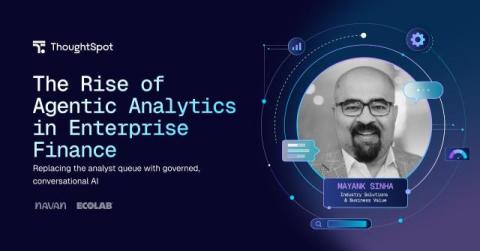
Agentic Analytics in Finance: Lessons from Navan and EcoLab

Finance leaders are operating in one of the most demanding macro environments in recent memory. Interest rates are moving faster than most models anticipated, reshaping the cost of capital almost overnight. Supply chain fragility has also turned working capital management into a moving target, and geopolitical uncertainty is changing how you plan for the future. Yet for many finance functions, the analytics stack hasn't kept pace with that urgency.