Systems | Development | Analytics | API | Testing

SaaS or on-premise? How to settle the Swagger deployment question

Choosing between SaaS and on-premise for SmartBear Swagger Studio, SmartBear Swagger Portal, and SmartBear Swagger Contract Testing The question that most often stalls an API solution evaluation is a simple one: do we run this as SaaS or on-premise? It’s simple to ask and hard to answer, because three teams each hold a veto. Security needs to know where your data will live. Your platform team has to decide whether it can take on another workload.
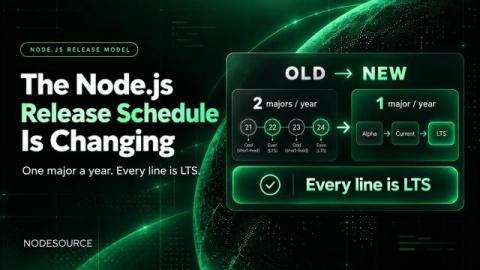

The Node.js Release Schedule Is Changing

One major per year, every major headed for LTS, and a new Alpha phase: here’s why Node.js is changing a release model that has been in place for more than a decade. For more than ten years, Node.js releases have followed a rhythm that became familiar across the ecosystem: a new major every six months, even-numbered releases moving into Long-Term Support, and odd-numbered releases serving as shorter-lived Current lines. That model brought something Node.js badly needed in 2015: predictability.

Healthcare IAM Trends: What's Shaping Identity Security in 2026

‍Healthcare identity and access management (IAM) controls access to clinical systems and patient information. It governs authentication, authorization, account provisioning, and access removal across connected healthcare environments. Healthcare IAM trends reflect expanding access requirements across employees, vendors, applications, and AI agents. Each identity needs defined permissions, accountable ownership, and monitoring appropriate to its operational role.

What Is a Control Plane for Enterprise AI? A Look Inside Klique

A control plane for enterprise AI is the layer between the people and agents using AI and the infrastructure that runs it, meaning your models, GPUs, clusters, and cloud accounts. It decides who can use what, sends each request to the right resource, and records what that request cost. Klique is the control plane for enterprise AI. Teams get self-service access to approved tools, models, and GPUs, and IT sets the policies, quotas, and budgets behind them.

The Top 5 Root Causes of False Failures in Test Automation And How AI Can Help Eliminate Them

False failures, a leading cause of flaky tests, occur when a test reports a defect that does not exist. The application works, yet the test suite says otherwise. The cost goes well beyond a few minutes of investigation. Perforce's 2026 State of DevOps Report found 50% of test failures stem from brittle scripts and UI changes, not actual defects, and 70% of automation effort goes toward fixing those scripts. Most teams are spending their automation budget on maintenance, not coverage.

New in PHP 8.6: Polling API

PHP 8.6 will include a new Polling API (RFC) that was developed as part of the PHP Foundation’s “Stream Improvement” project. Since we at Tideways place a special emphasis on PHP performance, we see this as a significant improvement for PHP users; one that has so far gone largely unnoticed by the PHP community. We hope that a wider audience will recognize its potential.

Manual Testers Are Getting Promoted

AI isn't coming for the manual tester's job. It's coming for the worst parts of it. What's left is the part you love, the part that always mattered most. And it's about to matter a lot more. There's a lot of talk right now about AI agents that can run the tests teams already have, keep them working as the application changes, and do it at a scale no team could staff. If you're a manual tester, I can guess what goes through your head when you read that. Great for the company. Where does it leave me?

What 2026 Building-Performance Requirements Reveal About Real Estate Data Infrastructure

2026 building-performance requirements increasingly depend on reliable property, meter, utility, and energy data, and that same normalized data can support compliance, reporting, analytics, and energy management. In 2026, several US jurisdictions reach building-performance deadlines, spanning recurring annual benchmarking, first-time compliance dates, and emissions-reduction requirements. The rules differ by jurisdiction, but many draw on the same property, meter, and utility records.

Making the Most of Your Logs in Rails

Rails logs through Rails.logger — on Rails 8.1, a BroadcastLogger that writes tagged lines to STDOUT in production and to log/development.log in development. Six levels exist: debug, info, warn, error, fatal, and unknown; production defaults to info via RAILS_LOG_LEVEL. Good log messages are descriptive, carry context like request IDs, and become structured JSON when machines read them.