Systems | Development | Analytics | API | Testing

SAP Data Migration and the 2027 Deadline: What Every Business Needs to Know Before It's Too Late

If your organization is still running SAP ECC, the clock is ticking. SAP has set 2027 as the end of mainstream maintenance for SAP ECC 6.0. This announcement means no more standard support, security patches, or bug fixes after that date. For large enterprises in manufacturing, food and beverage, pharma, chemicals, and logistics, the pressure to complete an S/4HANA migration before that deadline is becoming impossible to ignore. The risk isn’t just technical.

Advanced Object Recognition in Test Automation: Comparing Leading Enterprise Solutions

Object recognition is the capability of test automation tools to identify, locate, and interact with user interface elements within an application under test. It serves as the bridge between automated test scripts and the visual elements that end users see, enabling tests to accurately simulate user actions and validate application behavior.

AI Agent Testing Services

Your AI agent just placed 47 duplicate orders. It called the wrong API three times in a row. It looped through the same workflow for six minutes before anyone noticed. Nobody caught it in testing because nobody built the right tests. That's not a hypothetical. Enterprises using AI agents face this exact problem every week. The AI agent works perfectly in staging, but fails silently in production, and by the time the on-call engineer gets alerted, real customers are already affected.

LLM Testing Checklist: 50 Validations Before Production

A financial services startup launched its AI assistant without doing a proper LLM testing checklist. Within 72 hours, it gave three customers dangerous advice, telling them to withdraw their retirement savings and invest in penny stocks. The problem? The advice was completely made up. There was no validation, no factual grounding, just confident and detailed responses that were entirely wrong. The company then spent the next six months addressing regulatory issues and rebuilding customer trust.

ClearML Introduces Floating NVIDIA AI Enterprise License Management with One-click NVIDIA NIM Deployments

ClearML has announced native floating license management for NVIDIA AI Enterprise licenses with one-click deployment of NVIDIA NIM microservices across AI infrastructure. The feature, available now to ClearML enterprise customers, fundamentally changes how organizations consume NVIDIA AI Enterprise software licenses, moving from a static per-GPU assignment model to a dynamic pool that follows active workloads.

Government and Defense: Air-Gapped LLM Data Access | DreamFactory

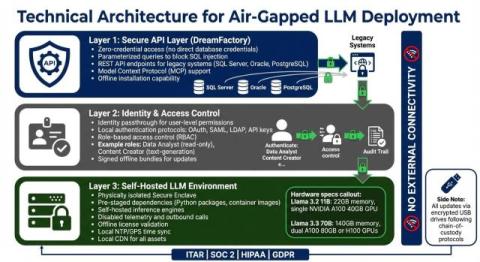
Government and defense agencies require extreme security measures to protect sensitive data like classified intelligence and military operations. Air-gapped systems, which are physically isolated from external networks, provide a robust solution by ensuring no remote access is possible. These systems are critical for deploying large language models (LLMs) safely in secure environments, enabling advanced AI capabilities like intelligence analysis and mission planning without risking data breaches.

Application Migration Simplified: How to Optimize Data for the Cloud

Organizations over the years have seen the writing on the wall: The future is cloud. Now, these companies and their DevOps teams areevolving, innovating, and pursuing new technologies, to gain a competitive edge and create new efficiencies. One of the ways they’re doing this is through application migration to cloud. In this blog, I’ll detail the nuances of application migration and how to best manage data during it, including various challenges and their solutions.

The missing transport layer in user-facing AI applications

Most AI applications start the same way: wire up an LLM, stream tokens to the browser, ship. That works for simple request-response. It breaks when sessions outlast a connection, when users switch devices, or when an agent needs to hand off to a human. The cracks appear in the delivery layer, not the model. Every serious production team discovers this independently and builds their own workaround. Those workarounds don't hold once users start hitting them in production.