
Systems | Development | Analytics | API | Testing

Case Study 2026: Scaling a SaaS Platform with AI-Powered Load Testing Insights

Consider a SaaS provider experiencing a sudden surge in demand. After years of steady expansion, a viral integration sends active user sessions soaring – tripling overnight. Onboarding speeds up, clients invite their own users, and the platform expands into new regions. With this momentum, the risks escalate: any downtime or performance issue now threatens not only revenue but also customer trust and regulatory standing.
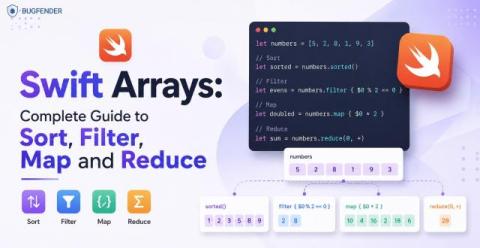
Swift Arrays: Complete Guide to Sort, Filter, Map and Reduce

Swift arrays are one of the most commonly used collection types in iOS and macOS development. They provide ordered, type-safe storage for values and include powerful higher-order functions such as map, filter, reduce, and sort. With value semantics, copy-on-write optimisation, and a rich set of built-in operations, Swift arrays make it easier to write safe, efficient, and expressive code. This guide will empower you to master the basics of Swift arrays and explore all the functionality they provide.

10 Signs You've Outgrown QuickBooks Inventory-and What to Do Next

As a business grows, inventory management becomes more complicated than simply knowing what is in stock. More products, additional sales channels, larger order volumes, and multiple storage locations can quickly turn a once-simple process into an operational challenge. QuickBooks Online offers useful built-in inventory management features for small businesses. It can help track inventory quantities, monitor stock levels, manage purchase orders, calculate inventory value, and keep accounting connected with everyday transactions.

The best GitHub Actions runners in 2026 (and hidden pricing traps to avoid)

GitHub Actions is the default CI/CD tool for most teams. The runners underneath it, the actual machines your jobs run on, are where the pain shows up. Standard GitHub-hosted runners are slow for heavy repos and complex workflows. The faster ones are gated behind Team and Enterprise plans. GitHub Actions pricing is also notoriously hard to understand, especially for macOS.

Mythbusting "PHP is rarely the bottleneck," data shows 40% of time spent in PHP

In discussions about PHP performance optimizations and micro-optimizations, there is often someone hand-waving the discussion down with, “PHP is rarely the bottleneck; I/O is.” But is that really true? Our data shows otherwise: across 1240 production projects, the average time spent in PHP is 40.3%. For 34% of these projects, they even spent more than 50% of their time in PHP, not in I/O. So, PHP often is the bottleneck, and depending on the framework, the effect is even higher.

How to get instant API test coverage with drift init | SmartBear Swagger Contract Testing

Learn how to generate API contract tests automatically from an OpenAPI specification using SmartBear Swagger Contract Testing's drift init command. Instead of writing tests endpoint by endpoint, you'll generate your first contract test suite in minutes. This video shows the full loop.

Building a Data Warehouse with the Astera AI Agent: From Prompt to Insight

Establishing a data warehousing system that meets all your business intelligence targets is by no means an easy task. It traditionally involves profiling source systems, designing a dimensional model by hand, writing the DDL to deploy it, building the load pipelines, and scheduling them to run, work that can take weeks. Astera's manual, step-by-step approach to this is covered in Building a Data Warehouse – A Step by Step Approach.

From Recommendation to Action: Scaling Autonomous Databricks Optimization in the Enterprise

Every Databricks optimization platform can tell you what should change. The harder question is: when should a system be trusted to make that change on its own? This session follows the journey of an Unravel customer as we moved from surfacing Databricks platform optimization recommendations to safely applying them in production. Prajakta will talk about the engineering decisions, the guardrails, and the trust model that made autonomous optimization possible in an environment where every change carries operational risk.