Systems | Development | Analytics | API | Testing

Ep 88 | AI Adoption vs. Adaptation: What Problem Are You Solving?

Paul McDonough-Smith estimates that many business leaders would struggle to define their organization’s problem clearly in fewer than 25 words. With AI, that lack of clarity can quickly turn into fragmented solutions and misplaced expectations. In this episode of The AI Forecast, Paul Muller sits down with Paul McDonough-Smith, a Visiting Senior Lecturer at MIT Sloan School of Management and a Senior Advisor to NASA's Goddard Space Flight Center, to explore how organizations can approach AI with greater clarity and purpose.

How AI Is Rebuilding the Insurance Claims Automation Lifecycle: The 2026 Guide

AI is restructuring how insurers run the claims lifecycle end to end from first notice of loss through payment and closure. This guide breaks down where AI insurance claims automation is delivering measurable results in 2026, the reference architecture behind it, and what insurers should prioritize first. Insurance claims automation 2026 connects AI, workflow orchestration, and core systems across the claims lifecycle the specific discipline behind Zymr’s own claims processing automation practice.

Add resumable streaming and reliable tool calling to your OpenAI agent

If you build an agent against OpenAI's Responses API then the simplest way to get output to the user is streaming over HTTP/SSE. If the user refreshes the page, loses connection, switches devices, or needs to approve a tool call, then there's nothing in the API to help you. AI Transport is Ably's session layer for agent-to-user conversations. An agent built on it gets resumable streams, multi-device sessions, and approval gates that wait for a human user, without deploying additional infrastructure.

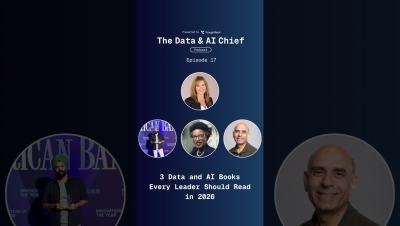
AI Changed Everything. Except What Matters.

AI changed the process, but not what matters. In the latest episode of The Data & AI Chief, three authors explore what it takes to lead through the AI era, from scaling innovation to building AI-ready data foundations to keeping humans at the center. This episode features: Linda Hill, Harvard Business School Professor and author of Genius at Scale, on scaling innovation and leading through uncertainty.

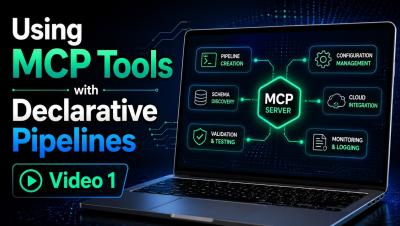
Using MCP Tools for Declarative Pipelines - Video 1

This is Part 1 of a two-part video series exploring how Qlik MCP tools can be used with declarative pipelines directly within VS Code. In this video, I demonstrate how to use the MCP tools to explore and validate your Qlik environment before building anything—identifying available connections, inspecting source tables, reviewing pipeline project information, and verifying the resources you plan to use.

Your AI investment has a governance gap, and it's called testing

Article Summary: Most teams have adopted AI coding tools, but testing is still manual, so the speed gain rarely survives to release. This post covers why that gap forms, how your team can maintain application integrity, and how QMetry’s AI features, from fast test creation to a Release Readiness Advisor, connect coverage, risk, and release decisions in one system instead of a second disconnected tool.

Where agentic AI is most valuable in performance testing

Quick summary: Performance teams can generate tests in minutes, but the analysis still takes hours. Agentic Performance Testing in NeoLoad uses domain-specialized AI agents to deliver a finished analysis from a single request, so engineers can start with the conclusions, rather than the raw data. Performance testing answers a critical question in the quality engineering lifecycle: will this hold up when real people use it, under real conditions, at real volume?

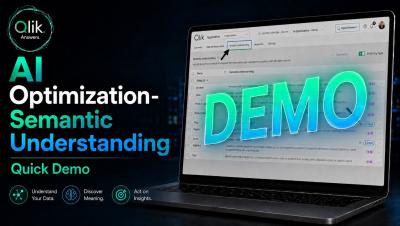
AI Optimization - Semantic Understanding - Quick Demo

AI Optimization is a workspace for managing how Qlik Answers understands an application. It brings semantic management into one experience, where you can review AI-generated semantic understanding and make corrections before they reach an answer. The result is a visible, correctable layer where there used to be none. AI Optimization is the central place to manage how Qlik Answers interprets your application. Semantic Understanding, inside it, shows and lets you edit this interpretation of each field and master item.

What's Driving the Great AI Re-Architecture?

As enterprise AI scales, traditional data architectures are reaching their limit. Workloads are becoming more distributed, data movement is accelerating, and tech leaders face growing pressure to justify AI spend while delivering real business impact. Chief Technology Officer Sergio Gago breaks down key findings from Cloudera’s latest global survey of enterprise architects, data architects, and cloud leaders.