Systems | Development | Analytics | API | Testing

Five Ways to Use OpenTelemetry Beyond Observability

OpenTelemetry graduated from the CNCF in May 2026 as, in the foundation’s own words, the de facto observability standard. The JavaScript API package alone did 1.36 billion downloads in twelve months. That kind of win has a side effect nobody plans for. Once a wire format is everywhere, has a receiver for every source, a transform language, and an agent your platform team already operates, people start putting things on it that have nothing to do with knowing whether a service is healthy.

New: Turn your reporting and analysis process into a reusable Skill

Getting work done with AI has never been faster. Give it a clear task, and it can complete in minutes what once took hours. Databox’s AI Analyst is a good example. Ask it to analyze the performance of your team or channels, and it can take the work from your initial question to a finished report in one conversation. The result, though, depends on the instructions you give it.

Test Management in the AI-Driven Era: What QA Teams Should Expect from Their Platform

Ask most QA teams how many tools it takes to manage one release and the list runs long: a repository for test cases, a separate grid for automated runs, a dashboard bolted on for reporting, and now an AI tool for generating or maintaining tests. Each has its own login, its own contract, and its own way of describing the same test case. That fragmentation is why "all-in-one test management platform" became the phrase buyers actually search for.

SAMA's Open Banking Licence is Live. Is Your Platform Ready to Prove It?

On 26 March 2026, the KSA Central Bank moved Open Banking out of its controlled sandbox and into a formal licensing regime, granting its first licences to Neotek and Lean Technologies on the same day. For KSA banks, this was more than a regulatory milestone it marks the moment when “being innovative” is no longer enough. Since March, SAMA has kept licensing new open banking and payment companies. More approvals came through the year, including in the second and third quarters.

The Smarter Safety Net: Modernizing User Acceptance Testing (UAT) with AI

Every engineering leader knows the scenario: sprint tickets are closed, unit coverage shows green across the board, API pipelines pass without a hitch, and the build is tagged "ready for release." Yet, the moment the software reaches actual business users, reality hits. A multi-tier approval workflow breaks on a regional tax calculation. An enterprise customer encounters friction during a custom bulk checkout.

Systematizing Interface Assets Across Distributed Teams

Managing a React component library for five independent product teams reveals a specific type of asset rot. Repositories fill up with disjointed vector files incredibly fast. One squad grabs a thick-lined navigation graphic for their dashboard. Another imports a hyper-detailed two-color asset for a settings panel. Suddenly, your platform interface looks like a patchwork quilt. Users notice these inconsistencies immediately.

The 8 Best Analytics Tools for SaaS Companies in 2026

The best analytics tools for SaaS companies in 2026 are Databox for cross-source reporting and AI analysis across revenue, marketing, and product data; Amplitude, Mixpanel, PostHog, and Heap for product analytics; Power BI for Microsoft-stack teams with a data function; and ChartMogul and Baremetrics for subscription revenue metrics. Eight tools, three jobs. Which job is yours decides the shortlist, and the tradeoffs below decide the pick.

Put Your Data to Work with ThoughtSpot in ChatGPT Work

Every organization says it wants self-service analytics, but very few have it. What actually stalls true self-service analytics is the invisible work that has to happen before anyone can ask a data question: the semantic layer, query engine, security model, and analytics app. That work lands on your product and data teams, who are already time-strapped to deliver core features and strategy, and it lands on them again every time a new question, a new tenant, or a new dashboard request arrives.

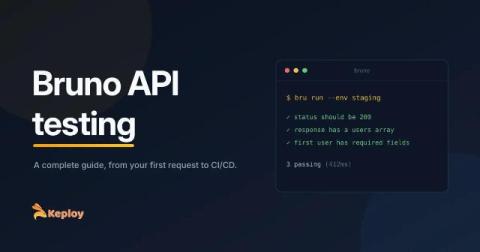
Bruno API Testing: A Complete Guide (2026)

Bruno is an open source, offline-first API client that stores your API collections as plain text files inside your Git repo. It gives you a fast GUI for building and sending REST, GraphQL, gRPC, and WebSocket requests, plus a scripting layer for writing tests against the responses. This guide covers Bruno API testing from install to CI, so by the end you can build a request, assert on its response, and run the whole suite from the command line.

Building an Agentic SOC on a Stream

Modern Security Operations Centers (SOCs) are transitioning towards agentic architectures. Traditionally, SOCs relied on rigid, rule-based automation and high human effort. We built an Agentic SOC powered by AI agents that don't just follow rigid, hardcoded rules, but also autonomously investigate, reason, and act like human analysts.